CHAPTER EIGHT — The Law of Self-Repair: Awareness and the Whole Human Being

This post belongs to a wider body of work that is being released in stages. It can be read on its own, or as part of the whole. The Prologue offers a natural point of entry for sequential reading.

“Energy equals mass times the speed of light squared.” — Albert Einstein

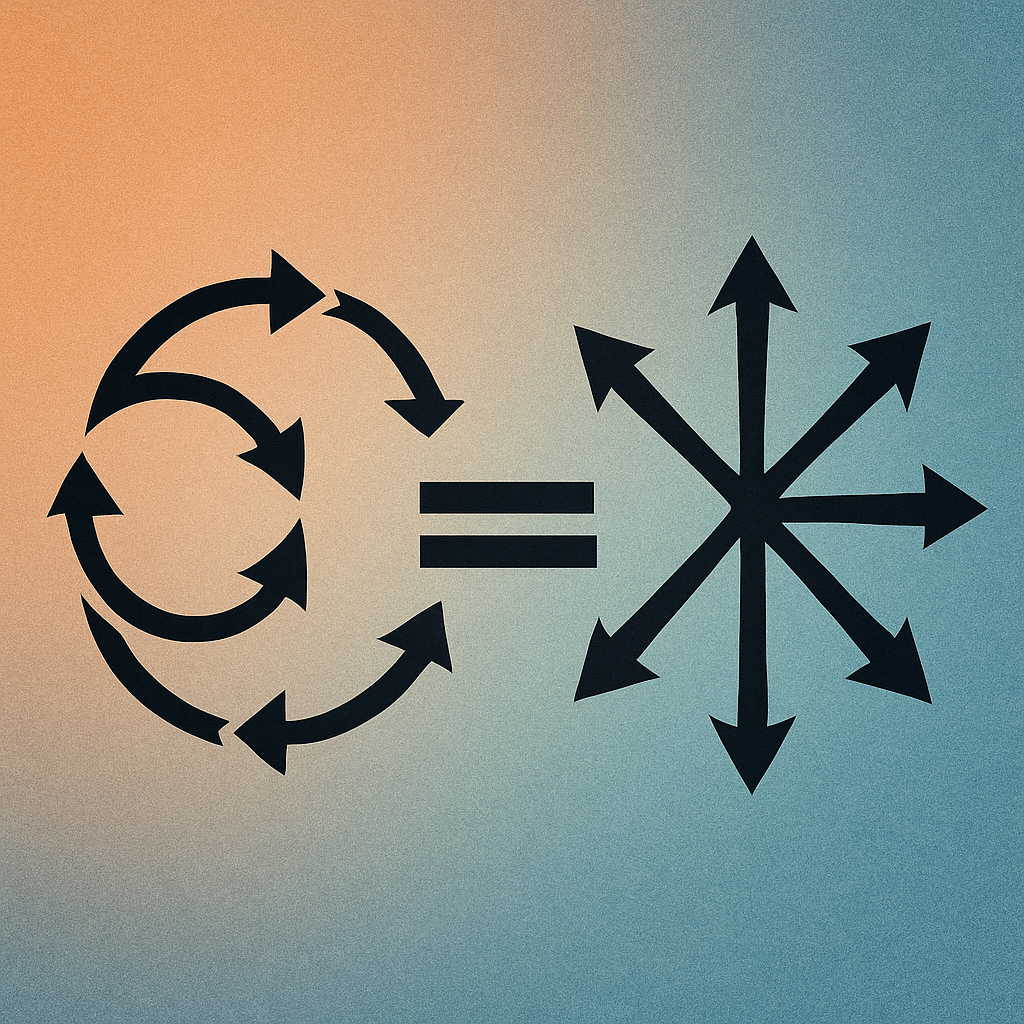
This is not metaphor. It is a working description of a closed system.

E = mc² holds because energy and matter are not rivals but expressions of one reality maintained through relationship. What makes the system viable is not either side of the equation, but what sits between them.

The equals sign.

Remove the equals sign and the system does not become freer; it becomes unstable. Energy overwhelms form, or form constrains energy until failure occurs. The problem is never energy itself or matter itself. The problem is the loss of regulation.

Human consciousness has suffered an equivalent structural failure.

For centuries, identity has been weighted almost entirely toward cognition, narrative, and effort. Conscience was reduced to belief, instruction, or compliance rather than recognised as a functional regulator within a living system. Thought became identity. The mind was treated as the whole.

The Twelve Step template corrects this error with unusual precision.

Step Three establishes the lower line of the equals sign: the embodied human being returning their will and life as they are — conditioned, conflicted, unfinished. This is not resignation; it is structural truthfulness.

Step Seven establishes the upper line: conscious alignment with the One beyond the personal system — not as belief, but as contact. Willingness replaces strain. Alignment replaces control.

Between these two lines, a third function becomes possible.

This is where Step Five must be understood accurately.

Step Five is not moral confession. It is the delivery of conscience. It is the moment awareness becomes accountable within relationship, rather than circulating privately inside the mind. Until this delivery occurs, conscience remains present only in potential — sensed but not governing.

Step Five places the central point between the lines.

This point is not judgement, diagnosis, or ideology. It is individuated conscience: the capacity to recognise alignment and misalignment in real time, from within the person, rather than imposed from outside. Clinically, this is the restoration of internal regulation through truthful disclosure.

This is the gain control. This is the regulatory function. This is the equals sign restored.

When conscience is absent, energy overwhelms form (compulsion, repetition, escalation), or form suppresses energy (numbing, rigidity, collapse). When conscience is present, the same forces move through the system without damage and generate coherence.

This chapter concerns that restoration — not the elimination of desire, but the regulation of power; not the dominance of mind, but its return to function; not separation from the body, but reintegration of mind, psyche, and organism into a single working system.



The modern world — including many professional healthcare workers — conflates emotions and feelings into one list. Yet they are not the same.

Feelings are the continuous pressure system of the psyche — ascending, descending, or neutral i.e. transcending — the inner equivalent of blood pressure.

Emotions are the barometric responses to those pressures — expressive weather systems, passing storms, momentary turbulence.

Feeling-pressure is the inner meteorology. Emotion is the barometer registering its movement.

Until conscience is delivered, these inner systems remain difficult to trust. Right and wrong are felt only dimly, borrowed from outside, or imposed as rules rather than recognised as alignment. The organism feels pressure, but does not yet know with itself what that pressure means.
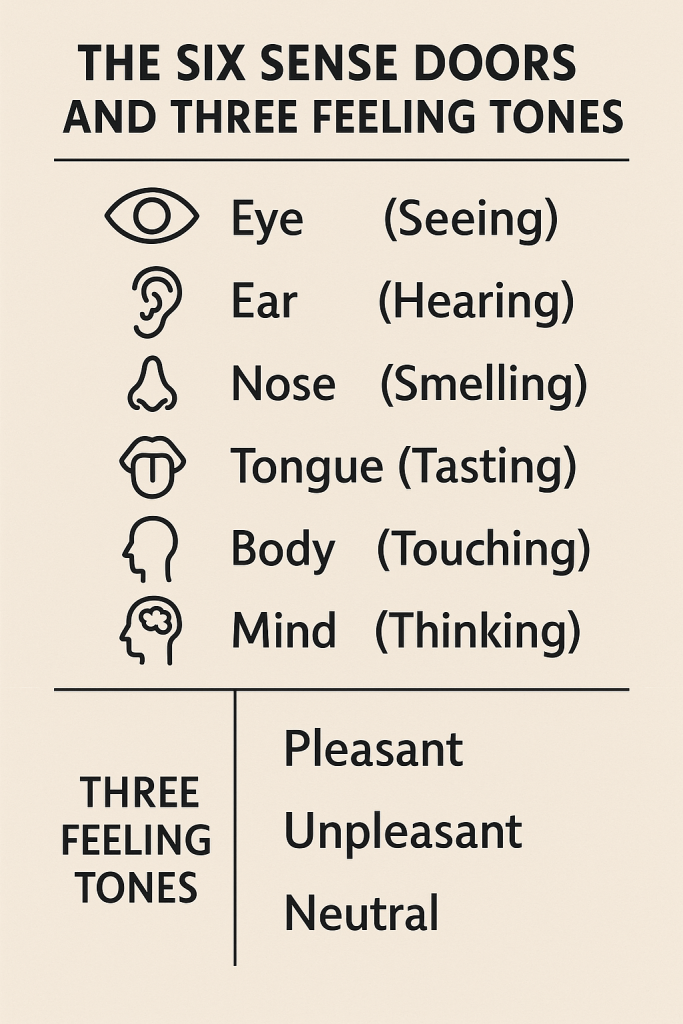


All experience enters through the five physical senses and was designed to be received by the mind, which is the stomach of the psyche. The mind is not a throne, not a control centre, not the essence of being. It is the digestive organ of inner life, receiving raw impressions as the body receives food — softening, mixing, breaking down, and integrating what comes in.

In the same way, conscience is not an abstract moral faculty. It emerges when digestion is restored — when experience has been received, broken down, and integrated rather than bypassed or acted out. Conscience cannot be installed. It must be born.

This digestion is continually heated and stirred by three biological instincts:

  • Sex instinct — toward union, creativity, pleasure
  • Social instinct — toward belonging, role, recognition
  • Security instinct — toward safety, control, continuity

These instinctual tones behave like thermal currents, shaping the texture of our inner weather.

But when the mind is lifted out of its digestive role and mistaken for the self — when it becomes a noun instead of the verb it was always meant to be — a catastrophic split begins. The mind becomes a box, a container in which a person attempts to live, separate from the organism that bears them.

Addiction arises as the organism’s desperate attempt to blow the box apart — to force a reunion between mind and psyche, and between psyche and the animal body. It is not merely escape; it is a violent attempt at reintegration.

In this sense, addiction is not the opposite of conscience but its precursor under pressure. The executive function — the capacity to bind, repeat, and devote — is alive and vital, yet ungoverned by an individuated knowing-with-self. Until conscience arrives, that binding power attaches to substitutes. The energy is not wrong. The marriage has not yet occurred.

When this split deepens, awareness detaches into a pod-like mind, floating above the living organism on a trickle charge of sensation and story. Detached awareness no longer inhabits the animal body, and so the person treats their own body in ways they would never treat a dog — with overwork, intoxication, deprivation, sedation, punishment, and neglect — not from cruelty, but from disconnection.

This disconnection is precisely what older spiritual language described as a second birth — not a conversion of opinion, but the delivery of conscience itself: the moment awareness becomes answerable and knowing becomes personal rather than theoretical.

At the heart of recovery is this revelation: the mind was never meant to be a noun. Its primary meaning is a verb: to mind — to care for, to attend to, to shepherd. This is the original function of mind in the architecture of Humankind.

In the Twelve Step Programme, this restoration occurs through a precise delivery apparatus. Steps Three, Seven, and Eleven restore contact — re-pairing the circuit so that consciousness is no longer running on a trickle charge. But contact alone is not sufficient. What follows is birth.
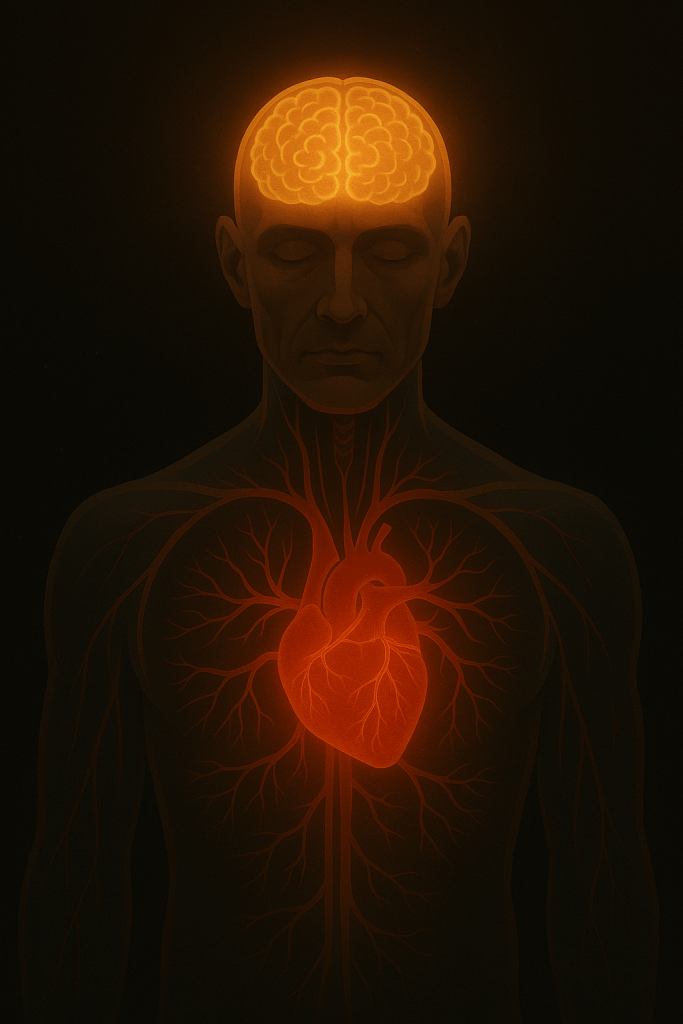


These insights do not arise from abstraction. They come from years of client work with cases that seemed impossibly complex — until the distinction between the two bodies became visible: the outer biological body and the inner ontological body of the psyche.

With up to forty thousand neurons in the heart, it is almost as if, in the end, the heart itself blows up the box of the mind. Where the noun-mind tries to contain experience, the heart forces reunion — bringing head and heart back together through a paradoxical collusion inside the sacred disease of stuck and broken addiction.

Steps One, Five, and Ten are not confessions in the moral sense. They are ad-missions — movements toward truth — the labour through which conscience is delivered into the present. The first birth brings a human into life; the second birth brings a human into responsibility.

For many, it is precisely addiction that exposes the failure of the mental box and compels the whole organism to seek unity again. And when this collapse meets the template of the Twelve Step Programme — a body of principles proven by lived evidence rather than theory — delusion is slowly dismantled.

In that process, healthy illusion is restored: the recognition that life is a play of energy experiencing itself through form. Not denial, not fantasy, but the rightful imaginative field in which a human being can live without fragmentation.

When conscience is born, illusion no longer deceives. It plays. Parable resumes its rightful function — carrying meaning across levels without freezing the soul’s development. Weaponised story arrests this second birth and leaves the person stalled between innocence and wisdom. Living story completes it.

The heart returns the mind to its verb-nature. The organism reclaims its person. And what was divided becomes whole enough to begin again.

Only now can consciousness carry its own preciousness through experience without fragmenting. Only now can the executive function bind the person to what serves life rather than substitutes for it. This is not virtue. It is alignment restored.

When clients see this clearly — the psychic stomach, the instinctual heats, the pressure system of feeling, the barometric nature of emotion, the pod-mind’s detachment — relief is palpable. Shame dissolves. Confusion lifts. A person sees themselves from the inside.

And then comes the great turning:

Both the outer body and the inner psyche heal by the same law.
When the wound is brought into awareness, the system moves toward self-repair.

Awareness is medicine because conscience is now present to receive it. Unity is the outcome because right and wrong have returned to relationship. The human being — mind, psyche, and animal body — begins its slow return from Mankind’s fragmentation to Humankind’s wholeness.

This is the return of Eden — not innocence regained, but innocence completed by wisdom. The One sees Itself through a unique, unrepeatable person, and love appears as recognition across difference.
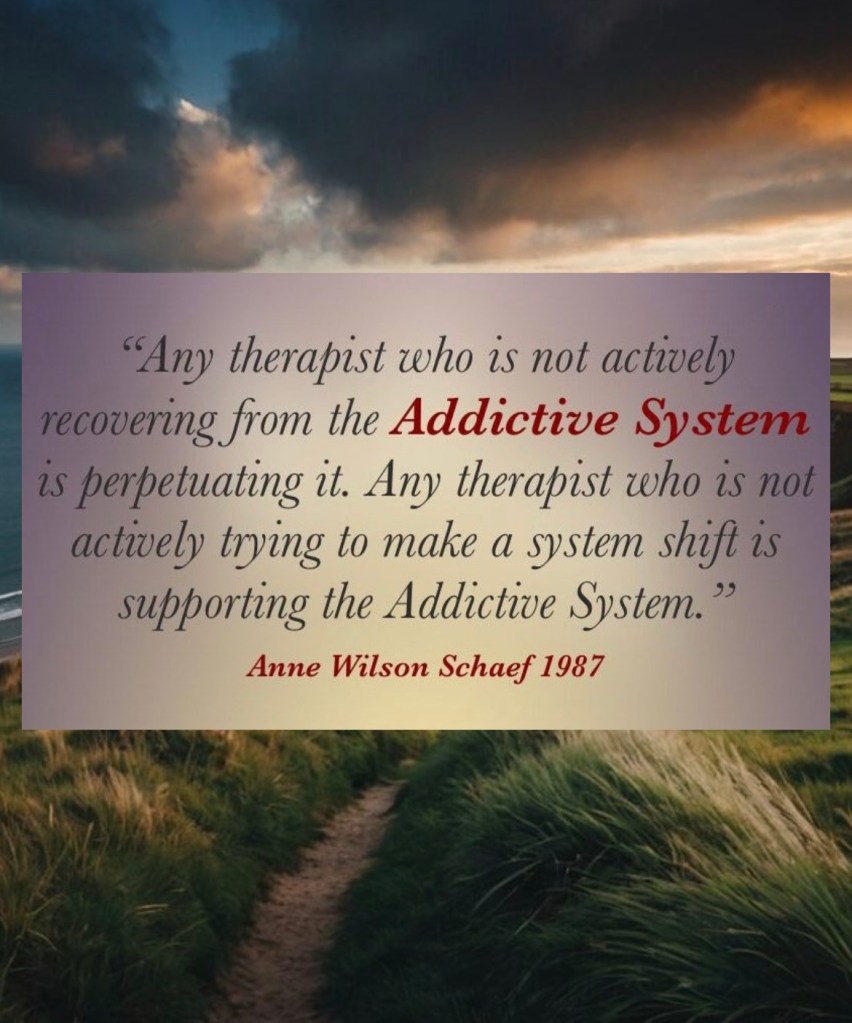
Anne Wilson Schaef named the Addictive System as a cultural field rather than an individual pathology. This observation is included here not as critique, but as a clinical orientation point.

What this reveals is not a technique of self-repair, but a relationship. Awareness does not restore coherence by force or control; it responds. When the whole human being is allowed to register experience without distortion, something larger than the individual appears to be met. Repair occurs as if the organism is answering a call already present — an order that precedes thought, belief, and method. Whatever name is given to this order, it cannot be reduced to psychology alone, yet psychology becomes intelligible in its light.


CHAPTER TEN — The Bridge of Denial

This post belongs to a wider body of work that is being released in stages. It can be read on its own, or as part of the whole. The Prologue offers a natural point of entry for sequential reading.

“As a flame trembles in a draught, so does the mind tremble before the coming of awakening.” — The Buddha (attributed)

The movement of a human life does not proceed in a straight line. It unfolds in pulses — contractions and expansions — the ancient rhythm by which consciousness learns, destabilises, reforms, and returns. Mystical traditions named this oscillation. Physics describes it as collapse and emergence. Recovery recognises it as surrender and awakening.

Scripture gave it a simpler name: denial.

Not refusal, not stubbornness, not moral failure — but the lawful trembling that occurs when an existing identity can no longer contain what is arriving. Denial is the hinge-state. The threshold. The necessary contraction before expansion.

This is why denial is never the opposite of awakening. It is its vestibule.

Across traditions, the same arc appears. In Surah ar-Raḥmān, creation is recited and a single refrain returns again and again: “Which of your Lord’s signs will you deny?” This is not accusation. It is diagnosis. It reveals precisely where consciousness has not yet stabilised enough to receive what is being shown.

The same pattern appears in the Gospel narrative of Peter’s denial — not as betrayal, but as the collapse of borrowed courage before the birth of embodied conscience. The old structure trembles. Something deeper prepares to arrive.

In clinical work, this same oscillation presents daily. What is often labelled relapse is better understood as awareness arriving before regulatory capacity is in place. Insight comes faster than the system can metabolise it. The psyche contracts not because truth is rejected, but because it has arrived too quickly.

From this perspective, denial is not opposition to recovery but a stabilising pause — a lawful threshold that appears when the organism is preserving coherence in the absence of sufficient internal regulation.

When denial is confronted prematurely, conscience fragments. When it is contained, paced, and accompanied, conscience consolidates. What follows is not regression but preparation.

This clarifies why the family of words rooted in sisto — to stand — carries such diagnostic precision: exist, resist, desist, persist, assist, consist. Each names a posture consciousness adopts while learning how to stand in truth without collapse.

Resistance and desist(ence) describe the same inner wrestle: the effort to remain standing long enough for understanding to arrive. Collapse occurs not because the person refuses truth, but because standing has not yet become possible.

This is where Twelve Step experience becomes indispensable.

Historically, members of Twelve Step fellowships were urged to remain under cover — not from shame, but for health. Groups functioned almost as hidden lodges, no less discreet than ancient Sufi tekkes. What current global conditions reveal is that it may no longer be addiction alone that requires protection. Normal living itself appears under strain.

In this context, the Twelve Step phenomenon reads less as a pathway back to a stable society and more as a surviving beachhead of sanity itself — a living memory of how conscience is restored when systems fragment.

The Twelve Steps, lawfully understood, do not manage behaviour. They construct a birth channel.

(Recall: Trust, Certainty, Patience, Resolution, Veracity — the five stations named in Sufi tradition — map precisely onto the Twelve Step arc, not as instruction but as remembered architecture.)

What is born through this channel is not abstinence, compliance, or belief. It is individuated conscience — the only place Universal Consciousness can reflect upon itself through a particular human being.

Modern culture often treats conscience as defective, punitive, or socially conditioned. Clinically, this is inaccurate. Conscience is not broken. It is delayed.

Each human being inherits provisional conscience fields — familial, cultural, historical — sufficient for survival but insufficient for individuation. These borrowed structures function temporarily. Eventually, they fail under the weight of lived reality.

The resulting collapse is not pathology. It is labour.

Addiction, breakdown, moral injury, and spiritual crisis are contemporary names for an ancient threshold: the point at which borrowed conscience can no longer carry experience, and a new centre must be born.

The Latin verb scire — to know — gives rise to science, conscious, and precious. These are not separate ideas. They describe one movement: knowing-with.

Pre-cious names what exists before full knowing — the seed of awareness placed within biology itself. This seed bears history, trauma, adaptation, and culture until it ripens.

When ripe, the disembodied mind — often experienced as a boxed control centre — enters crisis. The box appears to be destroyed. In truth, it is opening.

Conscience emerges not as an idea, but as a cervical opening in the psyche — a passage through which responsibility, humility, and contact can finally pass. This is why one moment of true reflection outweighs years of formalised performance. Reflection is consciousness recognising itself through a person.

Here, denial completes its work. What once protected the sleeper releases the awakened.

The bridge has done its job.

What follows is not collapse, but carriage — the ability to bear reality without fragmentation, to stand without resistance, and to move without fleeing.

This is where Chapter Eleven must begin: not with further diagnosis, but with the question of how a newly born conscience learns to live.

CHAPTER ELEVEN – EDUCATION LEADS OUT FROM WITHIN

This post belongs to a wider body of work that is being released in stages. It can be read on its own, or as part of the whole. The Prologue offers a natural point of entry for sequential reading.

What is born is a new attitude which must learn how to help the whole new relationship with the Creator to fly.

Chapter Ten described the birth of conscience. This chapter concerns its education.

Birth alone does not guarantee maturity. A newly born conscience is exquisitely sensitive, morally alive, and often unstable. Without structure, it can collapse into guilt. Without contact, it can inflate into righteousness. Without guidance, it can retreat into silence or dissociation.

What follows birth is not freedom, but learning.

Clinically, this is the phase where many people falter. The presenting problem has been interrupted. Insight has arrived. Contact is active. Yet something feels precarious. Old patterns no longer satisfy, but new ones have not yet consolidated. The person stands upright for the first time — and the world feels sharper, louder, more demanding.

This is not failure. It is proprioception returning.

The metaphor of standing and falling belongs first to the physical body. A baby finds its centre of gravity by falling, rising, and falling again until balance becomes native. But the education of conscience is not only a bodily matter. In the psyche, the governing metaphor is not walking but flying.

A conscience that has just been born does not simply learn to “stand.” It learns to cohere around a Higher Emotional Centre. It learns by ascent and misjudgement, flight and crash. These repetitions are not failures. They are re-petitions — calls back to Life for meaning, returns to the Source for re-orientation, renewed attempts at truthful alignment.

A conscience that has just been born feels everything. It registers misalignment instantly. It cannot yet discriminate between responsibility and omnipotence, between humility and self-erasure, between service and rescue.

The Twelve Step Programme anticipated this phase with remarkable accuracy.

Steps Ten, Eleven, and Twelve are not maintenance tools. They are educational structures. They teach conscience how to live inside time, relationship, error, repair, and uncertainty without reverting to old compensations.

This is why these Steps are lifelong. They do not complete recovery; they prevent conscience from being crushed by reality or intoxicated by insight.

Step Ten teaches proportionality. It restores scale.

A newly awakened conscience initially experiences everything as urgent. Every misstep feels catastrophic. Every failure appears global. Step Ten interrupts this distortion by introducing rhythm. Inventory becomes continuous, not dramatic. Repair becomes ordinary, not existential.

In the language of flight, Step Ten teaches what to do after a wobble, a dip, or a crash. It trains the person to correct course without spiralling into shame, and to admit error without surrendering the entire sky.

Clinically, this marks the movement from episodic shame to relational accountability. The person no longer requires collapse in order to remain honest. Truth can circulate without crisis.

Step Eleven teaches orientation.

Contact, once established, must be stabilised. Without orientation, conscience becomes reactive — pulled by circumstance, opinion, fear, or approval. Step Eleven restores vertical reference. It reminds the person that conscience answers upward before it answers outward.

This is not withdrawal from life. It is calibration.

Psychologically, this corresponds to the maturation of executive function in relationship to affect. Spiritually, it restores the axis between the created vehicle and the One who has all power. Practically, it prevents burnout, moral injury, and compulsive caretaking.

In live clinical and recovery settings, a phenomenological approach to Step Eleven has repeatedly shown the same outcome: when a person returns to orientation before reaction, reactivity softens, inner pressure becomes legible, and conscience regains altitude without inflation. The person does not become “better.” They become located.

Step Twelve teaches circulation.

What is not circulated stagnates. What stagnates corrupts. Conscience that remains private becomes brittle. Step Twelve returns conscience to the world — not as instruction, but as example; not as authority, but as availability.

This is why service stabilises recovery more reliably than insight. It places conscience back into relationship with unpredictability, difference, resistance, and need — without asking it to dominate or disappear.

Here, kind becomes decisive.

Kind is the behavioural expression of individuated conscience. It is not sentiment. It is not indulgence. It is discernment without violence.

In clinical terms, kind allows boundary without aggression, empathy without fusion, truth without humiliation. In recovery terms, it allows relapse to be addressed without moral collapse and success to be held without superiority.

In spiritual terms, kind is the signature of a conscience that has learned how to live — a conscience that can fly without fantasy and land without despair.

This is where the Human emerges — not as abstraction, but as a person capable of bearing contradiction without fragmentation.

Mankind operates through force, defence, and domination. Humankind operates through relation, responsibility, and response-ability. The bridge between them is not ideology. It is lived conscience, educated by error, tempered by humility, and sustained by contact.

This is why recovery does not end with awakening. Awakening that cannot walk becomes dangerous. Walking that forgets awakening becomes mechanical. The body must learn its balance; the psyche must learn its flight.

The work of Chapter Eleven is simple to state and difficult to embody:

to live as a conscience in the world without fleeing, fixing, or hardening.

When this becomes possible, something subtle but decisive shifts. The person no longer asks how to avoid falling. They ask how to re-orient quickly when they do — how to return to the vertical axis, how to re-enter the sky without grandiosity, how to serve without self-erasure.

This prepares the final movement.

Chapter Twelve will not add new material. It will release what has already been built.

Because what has been born, educated, and stabilised now carries its own momentum.

And the work no longer belongs to the book.

For readers unfamiliar with the Twelve Step structure referenced throughout this chapter, the full wording of the Steps (Second Edition, Alcoholics Anonymous) is provided in Appendix A as a stable reference.

CHAPTER TWELVE — The Holy Con (and the Launch of DRT)

This post belongs to a wider body of work that is being released in stages. It can be read on its own, or as part of the whole. The Prologue offers a natural point of entry for sequential reading.

This book has not been about addiction alone.

*A well-known ḥadīth qudsī, preserved in the Sufi tradition, expresses the mystery succinctly:

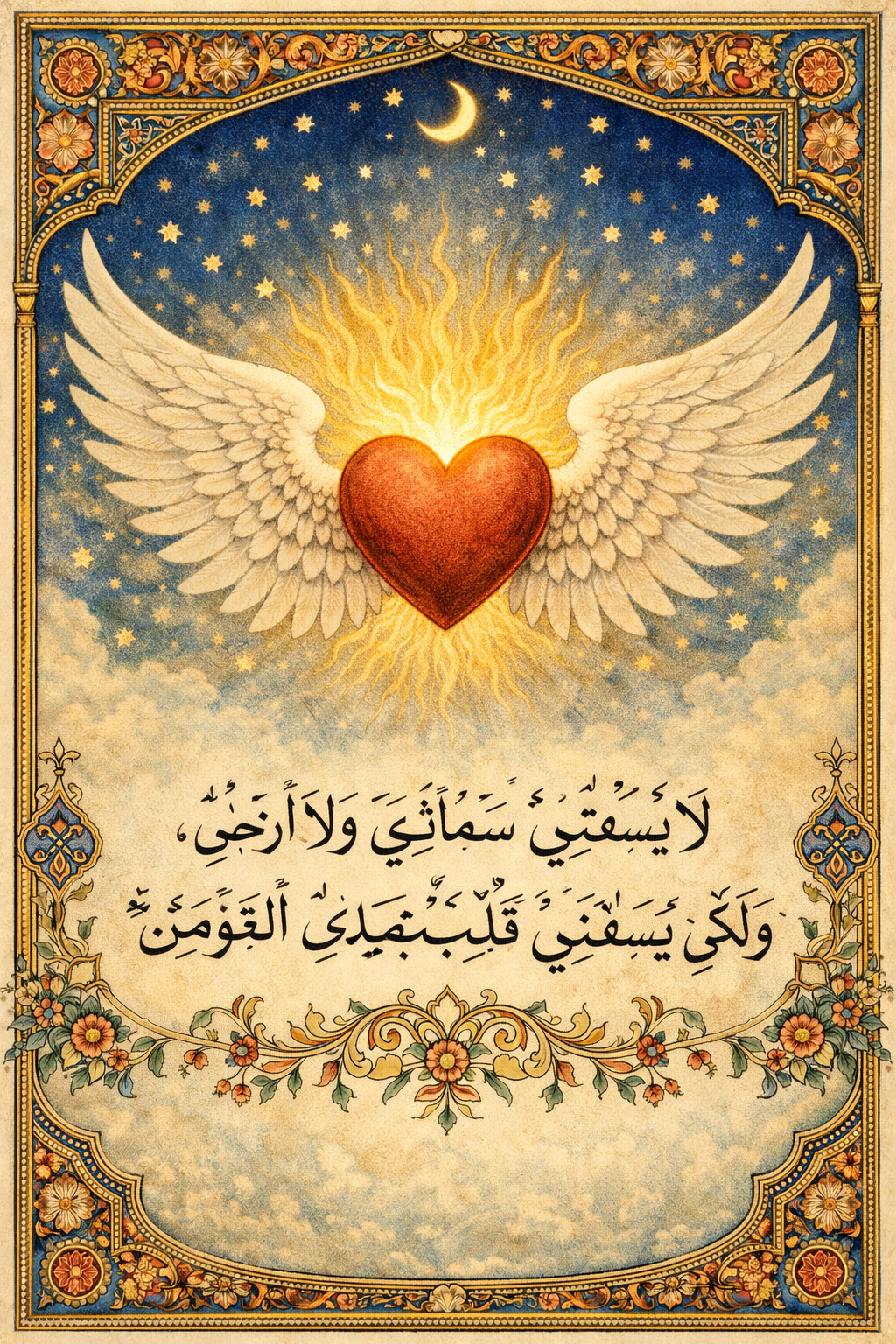
“Neither My heavens nor My earth contain Me, but the heart of My believing servant contains Me.”

This is not a statement of location, but of capacity — a language of presence, not possession.*

Addiction has been its doorway.

Throughout these chapters, addiction has been treated neither as moral failure nor as isolated pathology, but as a bellwether disease — an early warning signal of a deeper disorder unfolding within individuals, systems, and cultures.

Where addiction appears, something essential has been mis-governed. Where it persists, something essential has been silenced. Where it breaks through, something essential is attempting to be restored.

This is why addiction refuses to be resolved by technique alone. It is not a problem that yields to willpower, management, or substitution. It is a signal — often loud and destructive — that the human being has been cut off from the ground of their own Being.

The Holy Con names this cut.

The “con” is not deception in the everyday sense. It is the great misalignment in which the middle “I am” assumes the authority of the Big “I AM,” and subordinate spheres — money, identity, ideology, role, power, even religion — begin to claim keys they cannot hold.

This is the unholy con that has governed much of Mankind. It explains why systems multiply while meaning thins, why control increases while coherence collapses, and why both individuals and institutions oscillate between inflation and despair.

Addiction is the place where this con fails.

In the addicted person, compensations exhaust themselves. Executive function collapses. Behaviour loses flow. What remains is raw pressure — ascending and descending — demanding a resolution that management cannot provide.

This is why addiction so often coexists with insight, crisis, despair, longing, and unexpected spiritual awakening. The organism can no longer pretend. The false centre breaks.

The Holy Con names the reversal of this collapse.

It is the moment when misalignment is revealed not as personal failure, but as structural error. When conscience is born, educated, and stabilised. When the human being ceases to impersonate Being and instead learns to cooperate with it.

This cooperation does not remove difficulty. It restores order.

It is at this point that Diction Resolution Therapy (DRT) can be named clearly.

DRT is not a Twelve Step handbook, nor is it a replacement for the Twelve Step Programme. It is an orientation approach to behaviour change that has emerged through years of clinical practice in residential rehabilitation, prison-based recovery work, and ongoing therapeutic settings.

DRT concerns itself with the restoration of a three-part human template — commonly articulated in recovery dynamics as Spiritual, Mental, and Physical. When one part of this template is lost or collapsed into another, fear and resentment become dominant, and behaviour is recruited to manage pressures it cannot hold.

DRT works by attending to the interfaces between realms: the interface of the Invisible and the Mental, and the interface of the Mental and the Visible. It neither collapses these realms into one another nor privileges one at the expense of the rest.

The Visible Realm is further understood through universal instincts — Security, Social, and Sex — which belong to all Mankind and to most animal life. These instincts are not pathological. They are vehicles. When mis-governed, they dominate behaviour. When rightly oriented, they serve life.

Within this framework, addiction is understood not simply as substance use or compulsion, but as a breakdown in orientation — a state in which behaviour attempts to compensate for a collapse in the DICTION chamber, where BE, HAV(E), I, and OUR are no longer connected.

DRT therefore speaks of stuck-addiction and broken-addiction not as diagnoses, but as descriptive states within a wider aetiology of pressure, meaning, and disconnection.

The Twelve Step Programme appears throughout this book not as ideology, but as one of the most accurate cultural artefacts ever produced for navigating this territory. It does not explain the mystery. It builds a vessel capable of carrying it.

The Steps do not cause awakening. They create the conditions under which awakening can be survived.

DRT does not instrumentalise the Steps, nor does it subsume them. It stands alongside them as a conversational partner — an orientation that can interface with multiple Fellowships, counselling models, and evidence-based practices where openness to integration exists.

This book therefore marks the public emergence of DRT — not as a finished system, but as a living orientation. Further books will be required to expand these insights, grounded in the accumulated hours of clinical practice and lived recovery that cannot be compressed into a single volume.

The deeper purpose of this book has been singular:

to name the con that governs Mankind, and to reveal the holiness required to undo it.

If addiction is the bellwether disease of our time, then it is also a teacher. It asks, again and again, a question that systems prefer to avoid: What governs a human life?

This book does not answer that question for the reader. It restores the conditions in which the question can be faced.

The rest belongs to life.