CHAPTER SEVEN — THE ANCIENT ROOTS OF RECOVERY

This post belongs to a wider body of work that is being released in stages. It can be read on its own, or as part of the whole. The Prologue offers a natural point of entry for sequential reading.

“We are not human beings having a spiritual experience. We are spiritual beings having a human experience.” — Teilhard de Chardin

“The present difficulty is that the man thinks he is the doer… It is the Higher Power which does everything, and the man is only a tool.” — Ramana Maharshi

“There is only One, Unique, Absolute, Infinite Existence… He shows you He is yourself, then shows you that all else is Him.” — Bülent Rauf, Addresses II

“It is an evident fact that true communities and organisations ‘run down’ and develop peculiarities other than were present in their origins…” — Idries Shah, Learning How To Learn (The Coming Together Method)

There comes a point in this journey when the reader must be told something plainly:

The Twelve Step Programme, which has healed more lives from addiction than any other single framework in modern history, is not a modern invention. It is a rediscovery of principles that are ancient, subtle, and deeply rooted in the inner science of the soul.

Idries Shah called one aspect of this inner science “The Coming Together Method” — a way of dissolving ego, bringing people into the right kind of relationship, and allowing a higher intelligence to work through a group. Over time, he warned, such methods “run down” when their outer form is preserved but their inner purpose is forgotten.

The Sufis have known this for centuries: any living method can harden into structure, ritual, and habit. The original fire cools. The dance becomes choreography. Stabilisation replaces transformation. The same danger applies to all traditions — including, eventually, to the Twelve Step fellowships and any new work like DRT.

The Twelve Steps and the Ancient Arc

The Twelve Steps did not emerge from theology or psychology alone. They arose from lived desperation, filtered through a consciousness that happened, by grace, to align with an older design.

That design is expressed most directly in an ancient Sufi saying:

“I was a hidden treasure and I loved to be known. So I created the world that I should be known.”

This is the arc of Consciousness itself:

  • from hiddenness to manifestation,
  • from fragmentation to unity,
  • from isolation to Withness,
  • from Mankind to Humankind,
  • from de-pair into re-pair.

The Twelve Steps are effective because they align with this arc. They do not merely help people stop using a substance. They clear the obstructions that prevent the Hidden Treasure from being known through a human life.

Step One breaks the illusion of self-sufficiency. Step Two opens the possibility of a Greater Power. Step Three hands the ego’s steering wheel back. Steps Four through Nine cleanse and reorder the inner field. Steps Ten and Eleven maintain the relationship. Step Twelve lets the overflow serve others so it does not stagnate.

This is not moral reform. It is the architecture of Consciousness unfolding according to its original pattern.

The Journey From Desire to Decision

Before Step Four ever occurs, something quieter happens. Every genuine recovery begins with three movements:

  • Desire (Step One) — “I can’t do this anymore.” The collapse of the false self.
  • Possibility (Step Two) — “Maybe I can be helped.” A crack in the armour.
  • Decision (Step Three) — “I turn my will and life over…” A surrender of doership.

Ramana Maharshi described this moment perfectly: the human being suffers because they think they are the doer. Step Three ends that illusion.

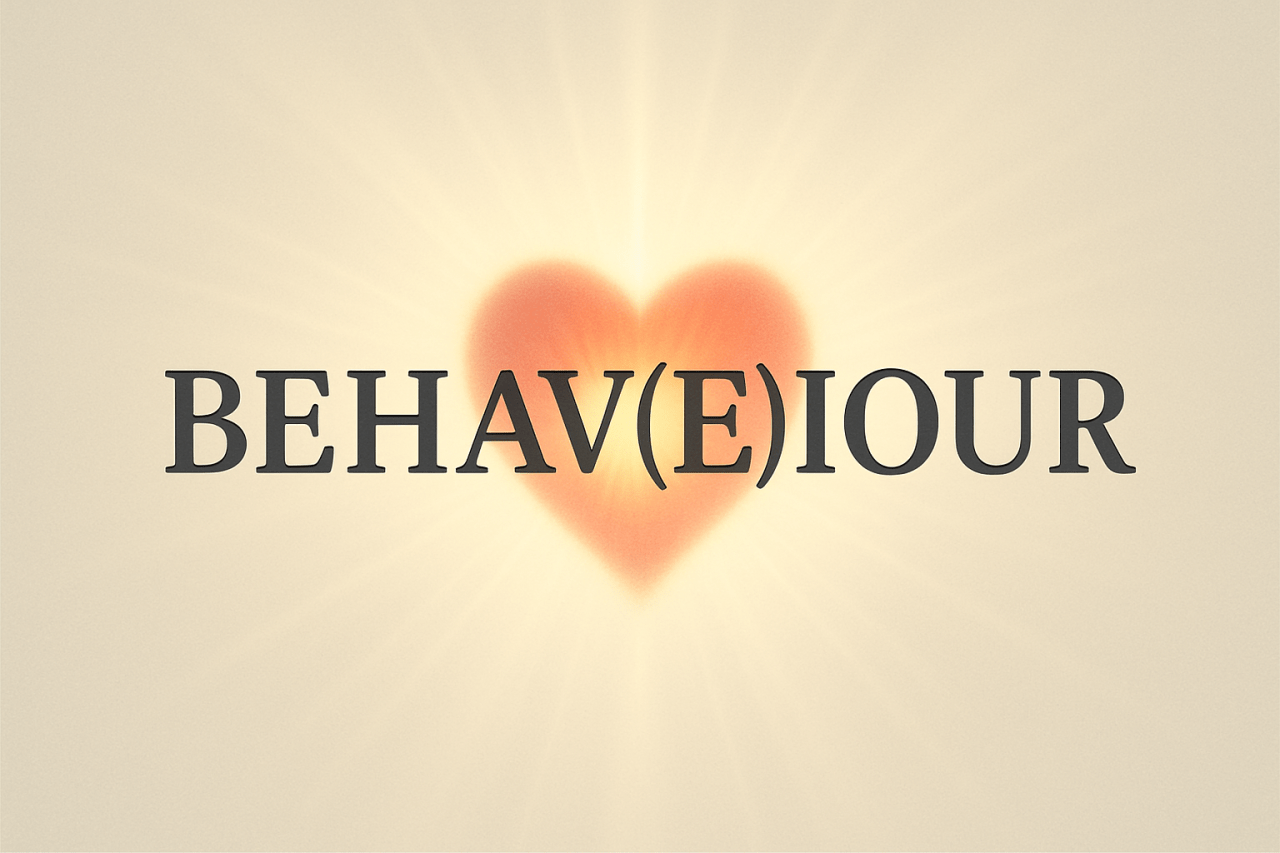
The Steps as Be–hav(e)–i–our

The deeper arc of the Twelve Steps is encoded in one English word: Be–hav(e)–i–our.

Steps One and Two form the ignition: the pressure of desire and the first glimmer of possibility. Without this ignition, nothing moves.

Then the word itself opens out as a map:

  • BE — Steps 3, 7, and 11
    These are the three alignments. Step 3 surrenders will and life. Step 7 surrenders self-architecture in humility. Step 11 surrenders isolation through conscious contact. Together they restore the person to Being — to the One who has all Power.
  • HAV(E) — Steps 4, 5, and 6
    Here the person works with what is held. Step 4 reveals it. Step 5 speaks it. Step 6 becomes entirely ready to let it go. This is the purification of the inner field so the Hidden Treasure can begin to shine.
  • I– — Steps 8, 9, and 10
    The “I” re-enters relationship. Step 8 prepares to repair. Step 9 enacts repair. Step 10 maintains repair through continual inventory. The isolated self is stitched back into the fabric of the All.
  • OUR — Step 12
    When the vessel is clear, it overflows. Step 12 is not duty but overflow: the recovered “I” becoming “our”, carrying the message to all who still suffer, living as an instrument of the One on behalf of the All.

This is not a clever play on a word. It is a behavioural anatomy that the Steps make visible: ignition in Steps 1 and 2; alignment in BE; purification in HAV(E); repair in I–; overflow in OUR.

The One and the All

There are two three-letter words that determine whether a person ripens into recovery. Neither is “God.” The words are One and All.

One is the recognition behind Step Three: that there is only One Power acting, one Reality moving everything, one Source living through every form.

All is the outward movement: making amends to all persons harmed; continuing in all our affairs; carrying the message to all who still suffer. Unity realised inwardly must express itself outwardly.

This is Ibn Arabi’s Journey to the Lord of Power: from the many to the One, and from the One back to the many, now perceived as One.

DRT and the Template of Hope

DRT does not exist to put everyone into a Twelve Step fellowship. Its task is subtler: to help people recognise that we are all living inside an Addictive System that fragments attention and de-pairs us from our own depth, from others, and from Source.

In such a world, the Twelve Step template becomes a universal architecture of hope — because its principles resonate with the original design of Consciousness. DRT does not force ripeness. It simply helps the tree reconnect with sun and water.

The Condition of the Vessel

The Hidden Treasure shines according to the condition of the vessel. A heart clouded by fear, shame, addiction, trauma, or left-hand dominance cannot reflect the Treasure clearly. The Treasure is not absent — merely obscured.

A muddy pool reflects nothing. When the water settles, the face of the sky appears.

The Steps do not ask people to “find God.” They ask them to settle the water. And when they do, even briefly, clarity appears, compassion rises, and human love becomes possible again.

DRT helps people recognise the state of their water. It names left-hand and right-hand conditions not as moral failings but as vibrational states. When the water clears, the movement toward Withness is natural.

A Physiology of Surrender

The body must become still before the soul can hear. A modern echo of this is the Relaxation Response: sit quietly, breathe gently, repeat a neutral word on the exhale, return gently when the mind wanders. This is not mysticism — it is physiological surrender.

The Coming Together Method, Now

Shah’s warning applies everywhere: when stabilisation replaces transformation, the water stagnates. The Coming Together Method existed to keep the inner fire alive. The Twelve Steps rediscovered this structure in the West. DRT now emerges as a clarifying bridge between them.

DRT does not ripen the fruit; it honours the design already in the human being — a design that began as a Hidden Treasure longing to be known.

Some will hear this as metaphor. Some will feel it as truth. Some will turn away until life ripens them further. But for those ready even a little, this recognition can be the beginning of peace.

In this way, the Twelve Steps, the Sufi method, and DRT are not three systems but three expressions of one arc, one mercy, one intention: that what was hidden may be known, and what is broken may become transparent enough for Light to pass through.

An Invitation to the Reader

If something in this chapter stirs you — a longing, a curiosity, a sense of recognition — honour it. You are not being asked to believe anything. You are being invited to look.

Research the names that draw you. Follow the threads that tug at you. Let your own curiosity become your guide. The One meets anyone who steps toward truth, and the All quietly rearranges itself to assist that step.

CHAPTER TEN — The Bridge of Denial

This post belongs to a wider body of work that is being released in stages. It can be read on its own, or as part of the whole. The Prologue offers a natural point of entry for sequential reading.

“As a flame trembles in a draught, so does the mind tremble before the coming of awakening.” — The Buddha (attributed)

The movement of a human life does not proceed in a straight line. It unfolds in pulses — contractions and expansions — the ancient rhythm by which consciousness learns, destabilises, reforms, and returns. Mystical traditions named this oscillation. Physics describes it as collapse and emergence. Recovery recognises it as surrender and awakening.

Scripture gave it a simpler name: denial.

Not refusal, not stubbornness, not moral failure — but the lawful trembling that occurs when an existing identity can no longer contain what is arriving. Denial is the hinge-state. The threshold. The necessary contraction before expansion.

This is why denial is never the opposite of awakening. It is its vestibule.

Across traditions, the same arc appears. In Surah ar-Raḥmān, creation is recited and a single refrain returns again and again: “Which of your Lord’s signs will you deny?” This is not accusation. It is diagnosis. It reveals precisely where consciousness has not yet stabilised enough to receive what is being shown.

The same pattern appears in the Gospel narrative of Peter’s denial — not as betrayal, but as the collapse of borrowed courage before the birth of embodied conscience. The old structure trembles. Something deeper prepares to arrive.

In clinical work, this same oscillation presents daily. What is often labelled relapse is better understood as awareness arriving before regulatory capacity is in place. Insight comes faster than the system can metabolise it. The psyche contracts not because truth is rejected, but because it has arrived too quickly.

From this perspective, denial is not opposition to recovery but a stabilising pause — a lawful threshold that appears when the organism is preserving coherence in the absence of sufficient internal regulation.

When denial is confronted prematurely, conscience fragments. When it is contained, paced, and accompanied, conscience consolidates. What follows is not regression but preparation.

This clarifies why the family of words rooted in sisto — to stand — carries such diagnostic precision: exist, resist, desist, persist, assist, consist. Each names a posture consciousness adopts while learning how to stand in truth without collapse.

Resistance and desist(ence) describe the same inner wrestle: the effort to remain standing long enough for understanding to arrive. Collapse occurs not because the person refuses truth, but because standing has not yet become possible.

This is where Twelve Step experience becomes indispensable.

Historically, members of Twelve Step fellowships were urged to remain under cover — not from shame, but for health. Groups functioned almost as hidden lodges, no less discreet than ancient Sufi tekkes. What current global conditions reveal is that it may no longer be addiction alone that requires protection. Normal living itself appears under strain.

In this context, the Twelve Step phenomenon reads less as a pathway back to a stable society and more as a surviving beachhead of sanity itself — a living memory of how conscience is restored when systems fragment.

The Twelve Steps, lawfully understood, do not manage behaviour. They construct a birth channel.

(Recall: Trust, Certainty, Patience, Resolution, Veracity — the five stations named in Sufi tradition — map precisely onto the Twelve Step arc, not as instruction but as remembered architecture.)

What is born through this channel is not abstinence, compliance, or belief. It is individuated conscience — the only place Universal Consciousness can reflect upon itself through a particular human being.

Modern culture often treats conscience as defective, punitive, or socially conditioned. Clinically, this is inaccurate. Conscience is not broken. It is delayed.

Each human being inherits provisional conscience fields — familial, cultural, historical — sufficient for survival but insufficient for individuation. These borrowed structures function temporarily. Eventually, they fail under the weight of lived reality.

The resulting collapse is not pathology. It is labour.

Addiction, breakdown, moral injury, and spiritual crisis are contemporary names for an ancient threshold: the point at which borrowed conscience can no longer carry experience, and a new centre must be born.

The Latin verb scire — to know — gives rise to science, conscious, and precious. These are not separate ideas. They describe one movement: knowing-with.

Pre-cious names what exists before full knowing — the seed of awareness placed within biology itself. This seed bears history, trauma, adaptation, and culture until it ripens.

When ripe, the disembodied mind — often experienced as a boxed control centre — enters crisis. The box appears to be destroyed. In truth, it is opening.

Conscience emerges not as an idea, but as a cervical opening in the psyche — a passage through which responsibility, humility, and contact can finally pass. This is why one moment of true reflection outweighs years of formalised performance. Reflection is consciousness recognising itself through a person.

Here, denial completes its work. What once protected the sleeper releases the awakened.

The bridge has done its job.

What follows is not collapse, but carriage — the ability to bear reality without fragmentation, to stand without resistance, and to move without fleeing.

This is where Chapter Eleven must begin: not with further diagnosis, but with the question of how a newly born conscience learns to live.

Affect, the Broken Word: Why Therapeutic Change Remains Elusive

A position paper from the DRT / HIAI collaboration, pointing toward The Holy Con.

Abstract

Contemporary psychology and counselling frequently rely on the concept of affect as a broad, interchangeable container for feeling, emotion, mood, temperament, and disposition. This paper argues that such usage obscures rather than clarifies human experience and contributes to the difficulty of achieving durable therapeutic change. Drawing on Diction Resolution Therapy (DRT), the paper proposes that the problem is not merely conceptual but linguistic and architectural: affect has been severed from its etymological family (-fect), resulting in a theory of inner life that cannot adequately account for governance, causation, transformation, or resolution. Reuniting affect with the wider -fect family — including prefect and perfect — restores a missing dimension of meaning and reopens the question of human perfectibility: the lawful transition from Mankind into Humankind.

1. The Problem with “Affect” as an Umbrella Term

In contemporary psychology, affect is often treated as a neutral umbrella term encompassing emotion, feeling, mood, affective state, disposition, and affectivity. As common definitions illustrate, these terms are frequently used interchangeably, with differences acknowledged but rarely operationalised in clinical practice.

This linguistic flattening produces several unintended consequences:

  • Feelings and emotions are treated as interchangeable phenomena
  • Enduring moods and momentary states are collapsed into the same category
  • Temperament is confused with situational response
  • Inner pressure and outer expression are blurred

The result is a therapeutic language that describes what is happening but struggles to explain how change happens.

Clients may feel understood, validated, and even regulated, yet still report that something essential remains untouched. Insight increases; coping improves; but transformation proves elusive.

2. The Missing Architecture: What DRT Observes

Diction Resolution Therapy begins from a different observation: feelings and emotions are not interchangeable, and neither is “affect” a sufficient container for them.

DRT distinguishes between:

  • Feelings as inner pressure states (ascending, descending, or neutral)
  • Emotions as barometric responses to events
  • Mood as a residual atmospheric condition
  • Temperament as a biological and developmental inheritance

When these are collapsed into “affect,” something vital disappears: the sense that something is acting upon something else, and that this action belongs within a governed inner order.

This disappearance is not accidental. It arises from affect being severed from its linguistic family — a family that carries not just experience, but agency, governance, and purpose.

3. The -FECT Family: Governance, Action, and Restoration

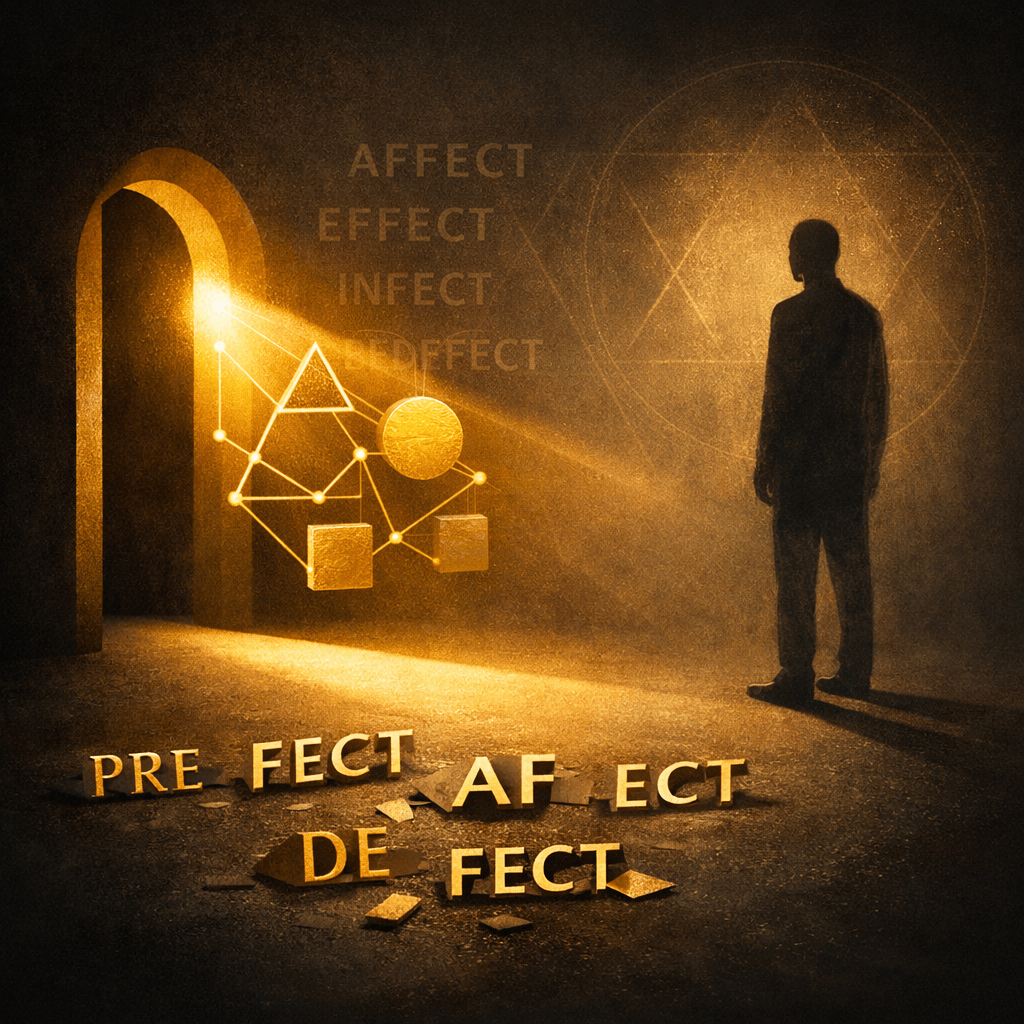
The Latin root facere (“to make, to do”) gives rise to a powerful and ordered family of words:

  • Prefect — the one placed in charge; the governing principle
  • Perfect — that which has been fully carried through to its proper end
  • Infect — something introduced that alters from within
  • Affect — to act upon; to influence
  • Effect — the result of that action
  • Defect — a failure of formation or governance
  • Refect / Refectory — restoration through nourishment
  • Confect / Confection — something made together

Within this family, affect is not a passive state. It is a moment in a sequence. Something is governed (prefect), acted upon (affect), produces consequences (effect), may collapse (defect), and can be restored (refect) — all within the horizon of perfectibility.

Modern affect theory isolates affect from this sequence and turns it into a descriptive fog — experience without governance, sensation without direction, feeling without an end.

DRT suggests that this linguistic amputation mirrors the therapeutic impasse: when we cannot name what governs the inner life, we cannot support its lawful restoration.

4. Why Change Becomes So Difficult

When affect is treated as a free-floating inner state:

  • Therapy focuses on regulation rather than re-ordering
  • Clients learn to manage experience rather than restore governance
  • Insight replaces transformation
  • Symptom relief substitutes for inner alignment

By contrast, when affect is reunited with the -fect family, a different therapeutic logic becomes available:

  • What has been infected into this person’s inner life?
  • What is currently affecting them?
  • What effects follow from this?
  • Where has governance (prefect) been displaced?
  • What defects in meaning or structure result?
  • What would genuine refection require?

Here, change is no longer heroic effort. It is the restoration of order.

5. Perfectibility: From Mankind to Humankind

The word perfect does not mean flawless. It means fully carried through.

DRT understands the human being not as broken beyond repair, but as perfectible — capable of lawful re-ordination when the right governance is restored.

This is the deeper movement from Mankind (the governed-by substitutes human) into Humankind (the human governed by Being).

Reuniting affect with its family restores the possibility of this movement — not as moral improvement, but as structural completion.

6. Toward The Holy Con

This paper points toward the larger argument developed in The Holy Con: that much of modern suffering — clinical, personal, and civilisational — arises from misnamed, mis-placed, and mis-governed inner realities.

Language is not secondary to healing. It is the architecture through which healing becomes possible.

To restore affect to its family is to restore the human being to the possibility of becoming fully human.