CHAPTER SEVEN — THE ANCIENT ROOTS OF RECOVERY

“We are not human beings having a spiritual experience. We are spiritual beings having a human experience.” — Teilhard de Chardin

“The present difficulty is that the man thinks he is the doer… It is the Higher Power which does everything, and the man is only a tool.” — Ramana Maharshi

“There is only One, Unique, Absolute, Infinite Existence… He shows you He is yourself, then shows you that all else is Him.” — Bülent Rauf, Addresses II

“It is an evident fact that true communities and organisations ‘run down’ and develop peculiarities other than were present in their origins…” — Idries Shah, Learning How To Learn (The Coming Together Method)

There comes a point in this journey when the reader must be told something plainly:

The Twelve Step Programme, which has healed more lives from addiction than any other single framework in modern history, is not a modern invention. It is a rediscovery of principles that are ancient, subtle, and deeply rooted in the inner science of the soul.

Idries Shah called one aspect of this inner science “The Coming Together Method” — a way of dissolving ego, bringing people into the right kind of relationship, and allowing a higher intelligence to work through a group. Over time, he warned, such methods “run down” when their outer form is preserved but their inner purpose is forgotten.

The Sufis have known this for centuries: any living method can harden into structure, ritual, and habit. The original fire cools. The dance becomes choreography. Stabilisation replaces transformation. The same danger applies to all traditions — including, eventually, to the Twelve Step fellowships and any new work like DRT.

The Twelve Steps and the Ancient Arc

The Twelve Steps did not emerge from theology or psychology alone. They arose from lived desperation, filtered through a consciousness that happened, by grace, to align with an older design.

That design is expressed most directly in an ancient Sufi saying:

“I was a hidden treasure and I loved to be known. So I created the world that I should be known.”

This is the arc of Consciousness itself:

  • from hiddenness to manifestation,
  • from fragmentation to unity,
  • from isolation to Withness,
  • from Mankind to Humankind,
  • from de-pair into re-pair.

The Twelve Steps are effective because they align with this arc. They do not merely help people stop using a substance. They clear the obstructions that prevent the Hidden Treasure from being known through a human life.

Step One breaks the illusion of self-sufficiency. Step Two opens the possibility of a Greater Power. Step Three hands the ego’s steering wheel back. Steps Four through Nine cleanse and reorder the inner field. Steps Ten and Eleven maintain the relationship. Step Twelve lets the overflow serve others so it does not stagnate.

This is not moral reform. It is the architecture of Consciousness unfolding according to its original pattern.

The Journey From Desire to Decision

Before Step Four ever occurs, something quieter happens. Every genuine recovery begins with three movements:

  • Desire (Step One) — “I can’t do this anymore.” The collapse of the false self.
  • Possibility (Step Two) — “Maybe I can be helped.” A crack in the armour.
  • Decision (Step Three) — “I turn my will and life over…” A surrender of doership.

Ramana Maharshi described this moment perfectly: the human being suffers because they think they are the doer. Step Three ends that illusion.

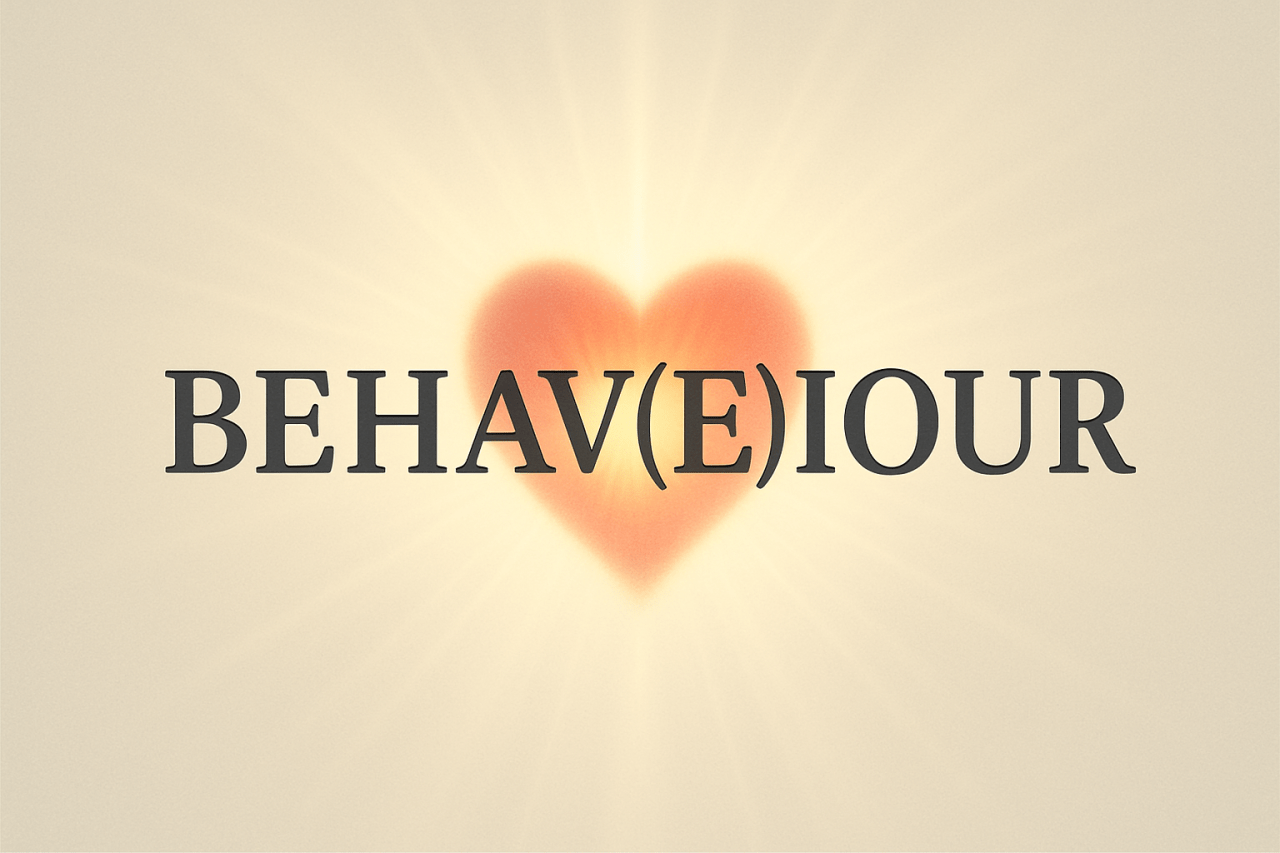
The Steps as Be–hav(e)–i–our

The deeper arc of the Twelve Steps is encoded in one English word: Be–hav(e)–i–our.

Steps One and Two form the ignition: the pressure of desire and the first glimmer of possibility. Without this ignition, nothing moves.

Then the word itself opens out as a map:

  • BE — Steps 3, 7, and 11
    These are the three alignments. Step 3 surrenders will and life. Step 7 surrenders self-architecture in humility. Step 11 surrenders isolation through conscious contact. Together they restore the person to Being — to the One who has all Power.
  • HAV(E) — Steps 4, 5, and 6
    Here the person works with what is held. Step 4 reveals it. Step 5 speaks it. Step 6 becomes entirely ready to let it go. This is the purification of the inner field so the Hidden Treasure can begin to shine.
  • I– — Steps 8, 9, and 10
    The “I” re-enters relationship. Step 8 prepares to repair. Step 9 enacts repair. Step 10 maintains repair through continual inventory. The isolated self is stitched back into the fabric of the All.
  • OUR — Step 12
    When the vessel is clear, it overflows. Step 12 is not duty but overflow: the recovered “I” becoming “our”, carrying the message to all who still suffer, living as an instrument of the One on behalf of the All.

This is not a clever play on a word. It is a behavioural anatomy that the Steps make visible: ignition in Steps 1 and 2; alignment in BE; purification in HAV(E); repair in I–; overflow in OUR.

The One and the All

There are two three-letter words that determine whether a person ripens into recovery. Neither is “God.” The words are One and All.

One is the recognition behind Step Three: that there is only One Power acting, one Reality moving everything, one Source living through every form.

All is the outward movement: making amends to all persons harmed; continuing in all our affairs; carrying the message to all who still suffer. Unity realised inwardly must express itself outwardly.

This is Ibn Arabi’s Journey to the Lord of Power: from the many to the One, and from the One back to the many, now perceived as One.

DRT and the Template of Hope

DRT does not exist to put everyone into a Twelve Step fellowship. Its task is subtler: to help people recognise that we are all living inside an Addictive System that fragments attention and de-pairs us from our own depth, from others, and from Source.

In such a world, the Twelve Step template becomes a universal architecture of hope — because its principles resonate with the original design of Consciousness. DRT does not force ripeness. It simply helps the tree reconnect with sun and water.

The Condition of the Vessel

The Hidden Treasure shines according to the condition of the vessel. A heart clouded by fear, shame, addiction, trauma, or left-hand dominance cannot reflect the Treasure clearly. The Treasure is not absent — merely obscured.

A muddy pool reflects nothing. When the water settles, the face of the sky appears.

The Steps do not ask people to “find God.” They ask them to settle the water. And when they do, even briefly, clarity appears, compassion rises, and human love becomes possible again.

DRT helps people recognise the state of their water. It names left-hand and right-hand conditions not as moral failings but as vibrational states. When the water clears, the movement toward Withness is natural.

A Physiology of Surrender

The body must become still before the soul can hear. A modern echo of this is the Relaxation Response: sit quietly, breathe gently, repeat a neutral word on the exhale, return gently when the mind wanders. This is not mysticism — it is physiological surrender.

The Coming Together Method, Now

Shah’s warning applies everywhere: when stabilisation replaces transformation, the water stagnates. The Coming Together Method existed to keep the inner fire alive. The Twelve Steps rediscovered this structure in the West. DRT now emerges as a clarifying bridge between them.

DRT does not ripen the fruit; it honours the design already in the human being — a design that began as a Hidden Treasure longing to be known.

Some will hear this as metaphor. Some will feel it as truth. Some will turn away until life ripens them further. But for those ready even a little, this recognition can be the beginning of peace.

In this way, the Twelve Steps, the Sufi method, and DRT are not three systems but three expressions of one arc, one mercy, one intention: that what was hidden may be known, and what is broken may become transparent enough for Light to pass through.

An Invitation to the Reader

If something in this chapter stirs you — a longing, a curiosity, a sense of recognition — honour it. You are not being asked to believe anything. You are being invited to look.

Research the names that draw you. Follow the threads that tug at you. Let your own curiosity become your guide. The One meets anyone who steps toward truth, and the All quietly rearranges itself to assist that step.

CHAPTER THREE — THE FEW WHO CARRY THE MANY

There is a mystery woven through the history of the world — a mystery that rarely appears in public, yet quietly shapes the fate of civilisations.

It is the mystery of how so few realised Human beings have ever walked the earth, and yet how astonishingly far their influence extends.

The number has always been small. Sometimes one in an age. Sometimes hidden entirely. Yet without them, the world would collapse.

The Sufis call such a being al-Qutb — the Pole, the axis around which the invisible order of the world turns. The Qutb is not recognised by earthly authority. He sits in no palace and rules no institution. But everything stable, everything merciful, everything quietly preserved is preserved because he stands.

In the Qur’an he appears as Khidr — the Green One, the guide Moses could not understand because Khidr moved by a law higher than law.

In the Christian imagination he appears as St George, not primarily as a dragon-slayer but as the defender of the innocent, the protector of what must be preserved.

In English folklore he surfaces again as Robin Hood, the outlaw who serves a deeper justice than the crown, aligned with the unseen moral order rather than earthly power.

Far to the East, in the mountains of Tibet, another whisper appears: that certain High Lamas, fully realised beings, sustain the balance of the world simply through their presence. Their monasteries were not just schools — they were tuning forks for the world’s spiritual field.

Most hidden of all is the lineage of the Sarmoung Masters of Wisdom, the Brotherhood said to have preserved the “bees’ knowledge,” refining and transmitting the nectar of divine wisdom across centuries so it would not be lost when civilisations collapsed.

The Sarmoung were custodians of humanity’s inner architecture — not to rule the world, but to keep it from dissolving from within.

At this point, we must remember what John G. Bennett said in his final public talk, distilling everything he learned from Gurdjieff, the Sarmoung, and decades of direct work with hidden traditions.
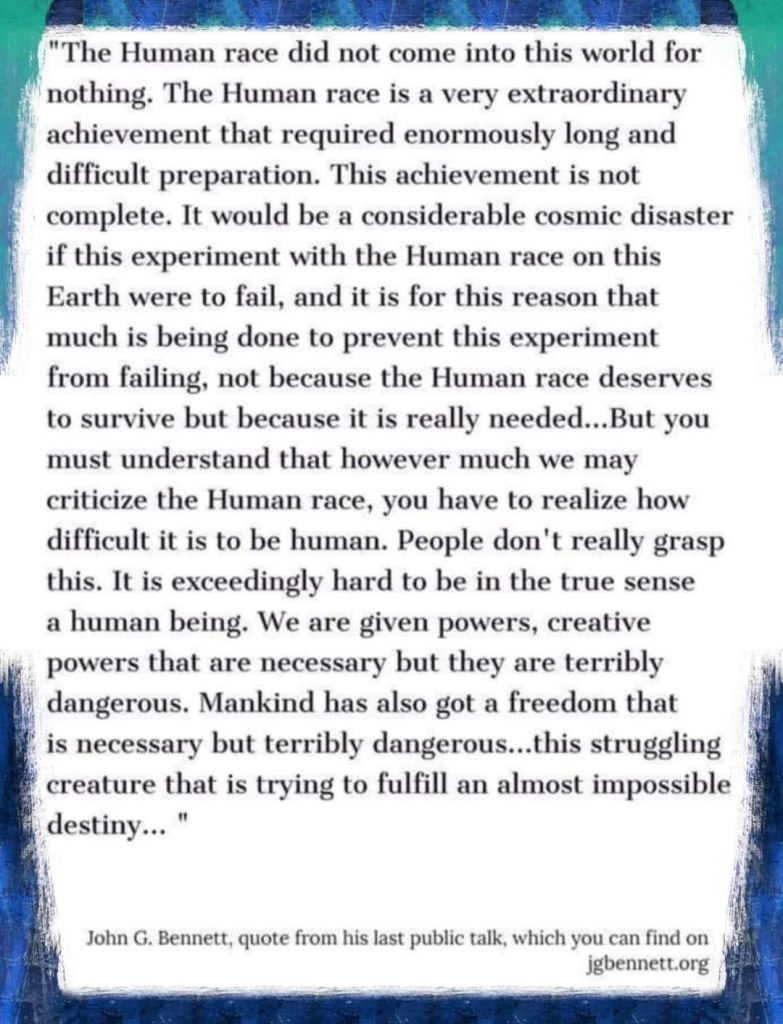
John G. Bennett quotation

Bennett understood what few dare to see: that the Human race is an unfinished experiment, extraordinarily difficult, and that the transition from Mankind to Humankind is not guaranteed. It requires help — not institutional help, but help from those few realised beings who have crossed the threshold and now bear the weight of the many.

Different continents. Different myths. Different languages. Yet all these traditions describe the same pattern: a small number of realised Human beings hold the world together from within.

They are not rulers. They are not prophets. They are not public figures. They are poles of stability, silent axes upon which the visible world unwittingly turns.

This is the Unseen Government — not a conspiracy, not a shadow elite, but a spiritual architecture that predates nations, institutions, and religions.

Those who belong to it walk with humility, often in obscurity, sometimes in disguise. Their presence radiates order into chaos, mercy into cruelty, balance into a world tipping toward collapse.

Every tradition carries a whisper of this group because the human soul remembers them, even when the mind does not.

Here is the great paradox: those who cross from Mankind into Humankind touch — even briefly — the edge of this current. The movement into alignment “with” the Real is the same movement that sustains the saints, the sages, the Green Man, the Sarmoung Masters, and the Lamas who hold the world upright.

The Twelve Steps tap into the same architecture: not through doctrine, but through alignment; not through belief, but through withness. Surrender brings a human being into contact with the same ancient field of support and governance.

When a person awakens into Humankind, even for a moment, they begin to bear what once crushed them. They join the current that has supported humanity since humanity first became capable of self-reflection. This is the ancient distinction between “the quick and the dead” — not in the crude sense of bodies and graves, but in the deeper sense recognised by the earliest Christians and later by the mystics: the difference between those who merely live, and those who have become alive.

This awakened aliveness — what some traditions name Christ consciousness — is not reserved for saints or prophets. It is the same shift made quietly, anonymously, in the Twelve-Step rooms for the last ninety years. Millions have brushed this threshold without ever naming it. The Steps, like the old Ways, do not create the Real; they align a person with it. They turn the deadened life of Mankind into the quickened life of Humankind.

This chapter opens that veil just enough to show that the crossing from Mankind to Humankind is not merely personal psychology. It is an initiation into a lineage. It is an entry into an ancient order. It is a step onto a Way guarded by Khidr, preserved by the Sarmoung, sustained by the Lamas, and anchored by the Qutb.

Whether we recognise it or not, every sincere seeker, every recovering person, every human who begins to walk “with” the Real is led by the same invisible hand.

And the Way continues, stone by unseen stone, because the hidden ones have always stood where the world would otherwise fall.