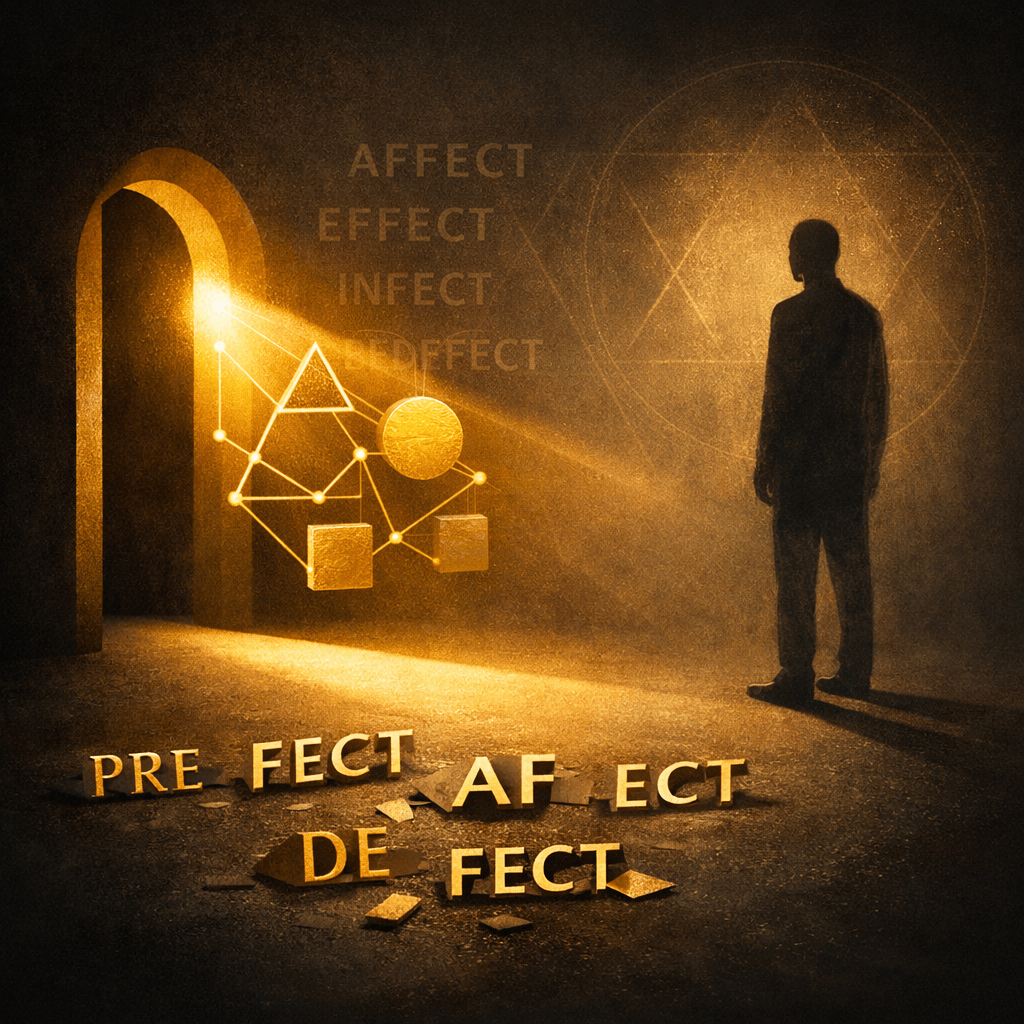
A position paper from the DRT / HIAI collaboration, pointing toward The Holy Con.
Abstract
Contemporary psychology and counselling frequently rely on the concept of affect as a broad, interchangeable container for feeling, emotion, mood, temperament, and disposition. This paper argues that such usage obscures rather than clarifies human experience and contributes to the difficulty of achieving durable therapeutic change. Drawing on Diction Resolution Therapy (DRT), the paper proposes that the problem is not merely conceptual but linguistic and architectural: affect has been severed from its etymological family (-fect), resulting in a theory of inner life that cannot adequately account for governance, causation, transformation, or resolution. Reuniting affect with the wider -fect family — including prefect and perfect — restores a missing dimension of meaning and reopens the question of human perfectibility: the lawful transition from Mankind into Humankind.
1. The Problem with “Affect” as an Umbrella Term
In contemporary psychology, affect is often treated as a neutral umbrella term encompassing emotion, feeling, mood, affective state, disposition, and affectivity. As common definitions illustrate, these terms are frequently used interchangeably, with differences acknowledged but rarely operationalised in clinical practice.
This linguistic flattening produces several unintended consequences:
- Feelings and emotions are treated as interchangeable phenomena
- Enduring moods and momentary states are collapsed into the same category
- Temperament is confused with situational response
- Inner pressure and outer expression are blurred
The result is a therapeutic language that describes what is happening but struggles to explain how change happens.
Clients may feel understood, validated, and even regulated, yet still report that something essential remains untouched. Insight increases; coping improves; but transformation proves elusive.
2. The Missing Architecture: What DRT Observes
Diction Resolution Therapy begins from a different observation: feelings and emotions are not interchangeable, and neither is “affect” a sufficient container for them.
DRT distinguishes between:
- Feelings as inner pressure states (ascending, descending, or neutral)
- Emotions as barometric responses to events
- Mood as a residual atmospheric condition
- Temperament as a biological and developmental inheritance
When these are collapsed into “affect,” something vital disappears: the sense that something is acting upon something else, and that this action belongs within a governed inner order.
This disappearance is not accidental. It arises from affect being severed from its linguistic family — a family that carries not just experience, but agency, governance, and purpose.
3. The -FECT Family: Governance, Action, and Restoration
The Latin root facere (“to make, to do”) gives rise to a powerful and ordered family of words:
- Prefect — the one placed in charge; the governing principle
- Perfect — that which has been fully carried through to its proper end
- Infect — something introduced that alters from within
- Affect — to act upon; to influence
- Effect — the result of that action
- Defect — a failure of formation or governance
- Refect / Refectory — restoration through nourishment
- Confect / Confection — something made together
Within this family, affect is not a passive state. It is a moment in a sequence. Something is governed (prefect), acted upon (affect), produces consequences (effect), may collapse (defect), and can be restored (refect) — all within the horizon of perfectibility.
Modern affect theory isolates affect from this sequence and turns it into a descriptive fog — experience without governance, sensation without direction, feeling without an end.
DRT suggests that this linguistic amputation mirrors the therapeutic impasse: when we cannot name what governs the inner life, we cannot support its lawful restoration.
4. Why Change Becomes So Difficult
When affect is treated as a free-floating inner state:
- Therapy focuses on regulation rather than re-ordering
- Clients learn to manage experience rather than restore governance
- Insight replaces transformation
- Symptom relief substitutes for inner alignment
By contrast, when affect is reunited with the -fect family, a different therapeutic logic becomes available:
- What has been infected into this person’s inner life?
- What is currently affecting them?
- What effects follow from this?
- Where has governance (prefect) been displaced?
- What defects in meaning or structure result?
- What would genuine refection require?
Here, change is no longer heroic effort. It is the restoration of order.
5. Perfectibility: From Mankind to Humankind
The word perfect does not mean flawless. It means fully carried through.
DRT understands the human being not as broken beyond repair, but as perfectible — capable of lawful re-ordination when the right governance is restored.
This is the deeper movement from Mankind (the governed-by substitutes human) into Humankind (the human governed by Being).
Reuniting affect with its family restores the possibility of this movement — not as moral improvement, but as structural completion.
6. Toward The Holy Con
This paper points toward the larger argument developed in The Holy Con: that much of modern suffering — clinical, personal, and civilisational — arises from misnamed, mis-placed, and mis-governed inner realities.
Language is not secondary to healing. It is the architecture through which healing becomes possible.
To restore affect to its family is to restore the human being to the possibility of becoming fully human.
 the HU man healing