CHAPTER ONE — THE TWO WAYS OF WITH

This post belongs to a wider body of work that is being released in stages. It can be read on its own, or as part of the whole. The Prologue offers a natural point of entry for sequential reading.

“The wound is the place where the Light enters you.” — Rumi

We live in a time when many people believe institutions are a con. But the word con never meant deception. Its root is the Latin cum — meaning with. And everything depends on this question: With what — or with whom — are we aligned?

This question opens the entire Way.

There is a con with a small c and a Con with a capital C. There is being with in a lesser way and being With in a greater way. There is Mankind and there is Humankind.

Mankind is the left-hand place — the state of being with the wrong thing: with the stuck behaviour, with the collapsing institution, with the ego attempting to self-govern what it cannot heal, with repetition rather than revelation, with survival rather than surrender.

Humankind is the right-hand place — the state of being with the right thing: with the Greater Power, with the breath of the Real, with the paradox that restores sanity, with Step Eleven consciousness, with the Creative Intelligence that the Twelve Steps return us to.

This is not moralism. This is alignment. This is orientation. This is the architecture of the soul. We are designed to get things wrong before we get things right, vice and virtue are in the very template of individuate wisdoms.

The DRT behaviour device shows this with elegant precision — a single vertical axis holding the left and right words, revealing the movement from Mankind toward Humankind.
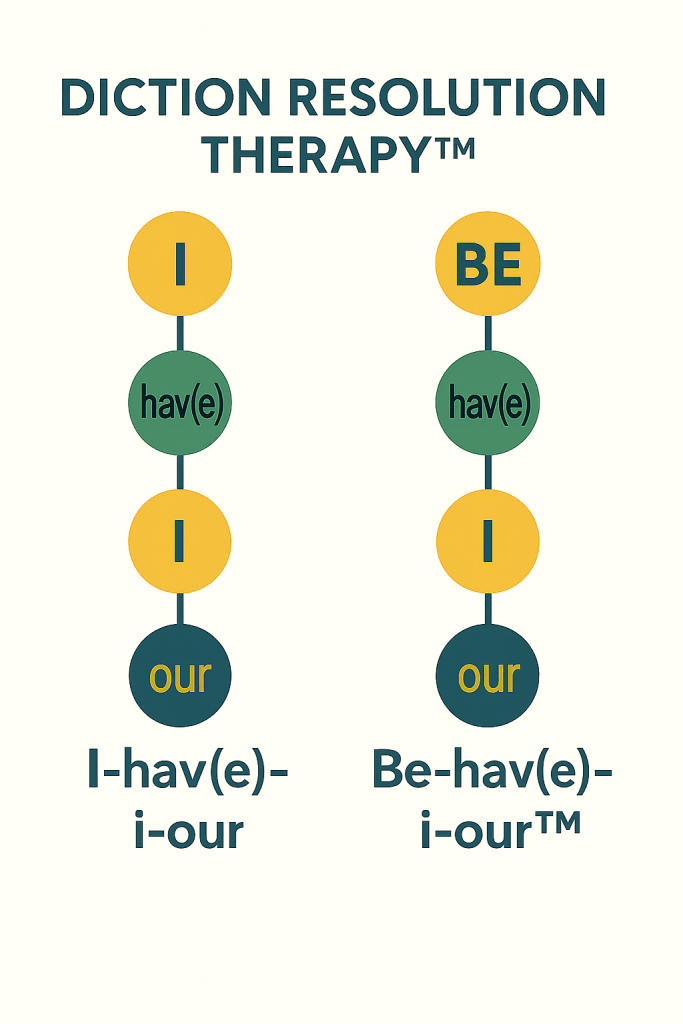
On the left-hand side is Mankind — the small con: being with the failing pattern, with the exhausted will, with the illusion of self-sufficiency.

On the right-hand side is Humankind — the great Con: being with the Higher Power, with humility, with paradox, with the Source that makes healing possible.

These two sides are never enemies. They are connected, paired, dependent — two poles of one paradox, the paradox through which transformation enters.

Wrong leans toward right. Right redeems wrong. The brokenness becomes the place of belonging. The collapse becomes the first clarity. The wound becomes the aperture for Light.

Our institutions are collapsing because they have remained too long in the realm of Mankind — with self-reference, with egoic governance, with structures cut off from their Source.

But collapse is not annihilation. Collapse is the small con exhausting itself. Collapse is the threshold of the great Con — the return of Humankind.

Every addict knows this. Every recovery room embodies this. Every true spiritual lineage teaches this.

A person recovers not by becoming stronger, but by becoming With. Not by reinforcing the ego, but by returning to Humankind.

A culture recovers in exactly the same way.

The question is always the same: Are we living as Mankind — or awakening as Humankind? What are we With? And what must we come-With next?

This is where The Holy Con begins — with the rediscovery of withness as the axis of healing, orientation, and return.

And the Way will appear as the next stone rises beneath the foot.
CHAPTER TWO — THE CIRCLE OF BIRTH AND BEARING

This post belongs to a wider body of work that is being released in stages. It can be read on its own, or as part of the whole. The Prologue offers a natural point of entry for sequential reading.

“Humankind is born of Mankind, then Mankind is borne by Humankind.” — A.J. Dettman

Every spiritual teaching worth its breath begins with a paradox — and this one is the doorway into the whole architecture of The Holy Con.

Humankind is born of Mankind. The higher emerges from the lower. The awakened self grows out of the wounded self. Consciousness rises through the very soil of unconsciousness.

This is why no stage of collapse is wasted. No failure is irrelevant. No addiction is outside the curriculum of awakening. The raw material of Humankind is always Mankind.

But the paradox does not end there.

Once Humankind is born, Mankind is no longer the carrier. The polarity reverses. The higher begins to bear the lower. Humankind carries Mankind. Humankind holds what once held it. Humankind becomes the shelter, the governance, the orientation, the right-hand alignment.

This is the turning at the heart of recovery, the pivot inside every Twelve Step experience, the movement from left-hand to right-hand in the DRT axis.

We begin in Mankind — with the ego, with self-will, with the illusion of personal mastery.

But when the self cannot carry the self any longer, Humankind is born — the capacity to be with the Greater Power, with surrender, with grace, with the paradox that reveals the next step.

And once Humankind rises, it begins the work of bearing Mankind.

This is why recovery does not erase the wound — it carries it. Transforms it. Bears it as a mother bears a child and as a child in adulthood bears the aging mother.

The relationship reverses but the bond remains.

This is why opposites are always connected. Wrong and right. Collapse and renewal. Mankind and Humankind. Con and con. Two aspects of one unfolding. Two poles of one mercy.

Every addict knows this circle. Every mystic lives it. Every civilisation, when it collapses and rises, confirms it.

Humankind is not another species. It is Mankind transfigured. Mankind relieved of the burden of carrying itself. Mankind lifted into alignment with the creative Force it forgot.

And when Humankind takes up its place, it begins to bear Mankind with tenderness — not condemnation, not avoidance, not disgust, but recognition.

Because Humankind remembers what Mankind forgets: that every fall is formative, every collapse is instructive, every darkness is a womb.

This is why the Holy Con is not a movement of escape but a movement of withness. Not leaving the old behind but carrying it rightly, through a new alignment with the paradox that makes transformation possible.

Humankind is born of Mankind. Then Mankind is borne by Humankind. Birth and carrying. Collapse and bearing. Left and right. The small con and the great Con. One circle. One unfolding. One mercy.

And the Way continues, stone by unseen stone, as we follow the curve of what carries us next.

CHAPTER THREE — THE FEW WHO CARRY THE MANY

This post belongs to a wider body of work that is being released in stages. It can be read on its own, or as part of the whole. The Prologue offers a natural point of entry for sequential reading.

There is a mystery woven through the history of the world — a mystery that rarely appears in public, yet quietly shapes the fate of civilisations.

It is the mystery of how so few realised Human beings have ever walked the earth, and yet how astonishingly far their influence extends.

The number has always been small. Sometimes one in an age. Sometimes hidden entirely. Yet without them, the world would collapse.

The Sufis call such a being al-Qutb — the Pole, the axis around which the invisible order of the world turns. The Qutb is not recognised by earthly authority. He sits in no palace and rules no institution. But everything stable, everything merciful, everything quietly preserved is preserved because he stands.

In the Qur’an he appears as Khidr — the Green One, the guide Moses could not understand because Khidr moved by a law higher than law.

In the Christian imagination he appears as St George, not primarily as a dragon-slayer but as the defender of the innocent, the protector of what must be preserved.

In English folklore he surfaces again as Robin Hood, the outlaw who serves a deeper justice than the crown, aligned with the unseen moral order rather than earthly power.

Far to the East, in the mountains of Tibet, another whisper appears: that certain High Lamas, fully realised beings, sustain the balance of the world simply through their presence. Their monasteries were not just schools — they were tuning forks for the world’s spiritual field.

Most hidden of all is the lineage of the Sarmoung Masters of Wisdom, the Brotherhood said to have preserved the “bees’ knowledge,” refining and transmitting the nectar of divine wisdom across centuries so it would not be lost when civilisations collapsed.

The Sarmoung were custodians of humanity’s inner architecture — not to rule the world, but to keep it from dissolving from within.

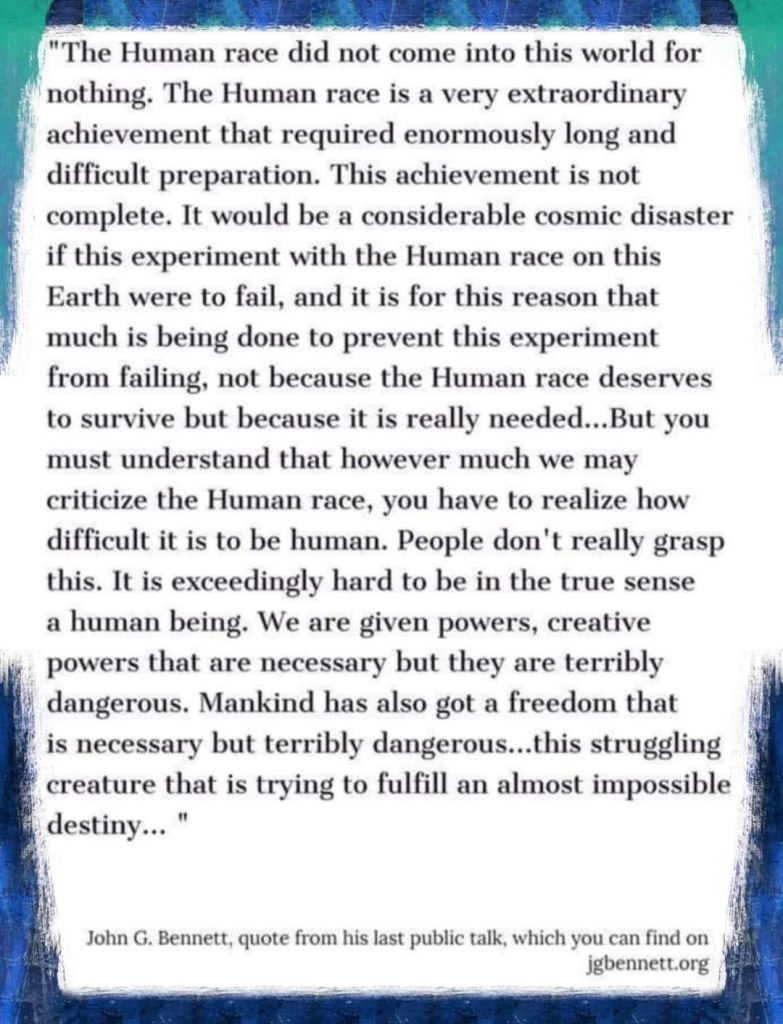
At this point, we must remember what John G. Bennett said in his final public talk, distilling everything he learned from Gurdjieff, the Sarmoung, and decades of direct work with hidden traditions.

John G. Bennett quotation

Bennett understood what few dare to see: that the Human race is an unfinished experiment, extraordinarily difficult, and that the transition from Mankind to Humankind is not guaranteed. It requires help — not institutional help, but help from those few realised beings who have crossed the threshold and now bear the weight of the many.

Different continents. Different myths. Different languages. Yet all these traditions describe the same pattern: a small number of realised Human beings hold the world together from within.

They are not rulers. They are not prophets. They are not public figures. They are poles of stability, silent axes upon which the visible world unwittingly turns.

This is the Unseen Government — not a conspiracy, not a shadow elite, but a spiritual architecture that predates nations, institutions, and religions.

Those who belong to it walk with humility, often in obscurity, sometimes in disguise. Their presence radiates order into chaos, mercy into cruelty, balance into a world tipping toward collapse.

Every tradition carries a whisper of this group because the human soul remembers them, even when the mind does not.

Here is the great paradox: those who cross from Mankind into Humankind touch — even briefly — the edge of this current. The movement into alignment “with” the Real is the same movement that sustains the saints, the sages, the Green Man, the Sarmoung Masters, and the Lamas who hold the world upright.

The Twelve Steps tap into the same architecture: not through doctrine, but through alignment; not through belief, but through withness. Surrender brings a human being into contact with the same ancient field of support and governance.

When a person awakens into Humankind, even for a moment, they begin to bear what once crushed them. They join the current that has supported humanity since humanity first became capable of self-reflection. This is the ancient distinction between “the quick and the dead” — not in the crude sense of bodies and graves, but in the deeper sense recognised by the earliest Christians and later by the mystics: the difference between those who merely live, and those who have become alive.

This awakened aliveness — what some traditions name Christ consciousness — is not reserved for saints or prophets. It is the same shift made quietly, anonymously, in the Twelve-Step rooms for the last ninety years. Millions have brushed this threshold without ever naming it. The Steps, like the old Ways, do not create the Real; they align a person with it. They turn the deadened life of Mankind into the quickened life of Humankind.

This chapter opens that veil just enough to show that the crossing from Mankind to Humankind is not merely personal psychology. It is an initiation into a lineage. It is an entry into an ancient order. It is a step onto a Way guarded by Khidr, preserved by the Sarmoung, sustained by the Lamas, and anchored by the Qutb.

Whether we recognise it or not, every sincere seeker, every recovering person, every human who begins to walk “with” the Real is led by the same invisible hand.

And the Way continues, stone by unseen stone, because the hidden ones have always stood where the world would otherwise fall.

CHAPTER TWELVE — The Holy Con (and the Launch of DRT)

This post belongs to a wider body of work that is being released in stages. It can be read on its own, or as part of the whole. The Prologue offers a natural point of entry for sequential reading.

This book has not been about addiction alone.

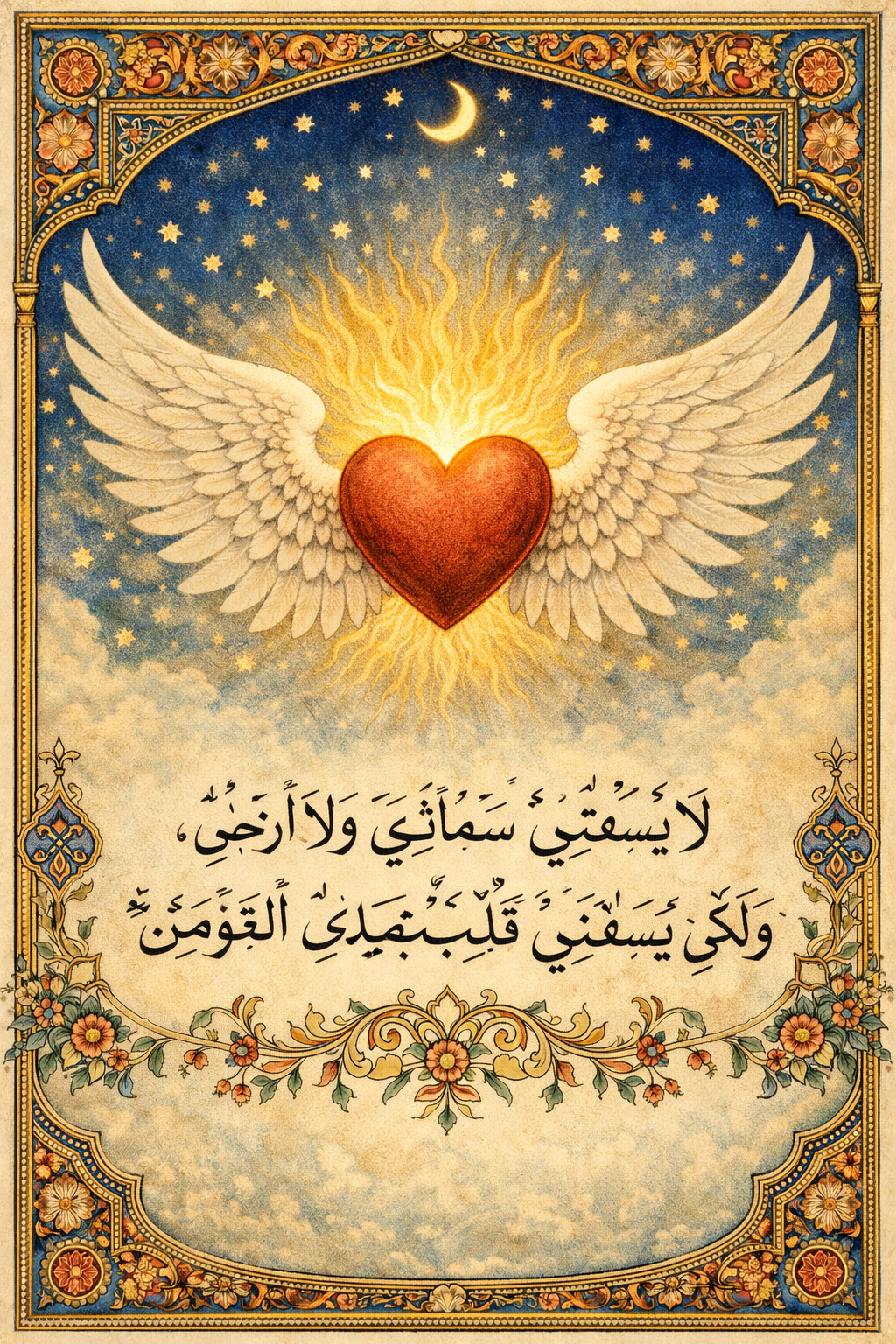
*A well-known ḥadīth qudsī, preserved in the Sufi tradition, expresses the mystery succinctly:

“Neither My heavens nor My earth contain Me, but the heart of My believing servant contains Me.”

This is not a statement of location, but of capacity — a language of presence, not possession.*

Addiction has been its doorway.

Throughout these chapters, addiction has been treated neither as moral failure nor as isolated pathology, but as a bellwether disease — an early warning signal of a deeper disorder unfolding within individuals, systems, and cultures.

Where addiction appears, something essential has been mis-governed. Where it persists, something essential has been silenced. Where it breaks through, something essential is attempting to be restored.

This is why addiction refuses to be resolved by technique alone. It is not a problem that yields to willpower, management, or substitution. It is a signal — often loud and destructive — that the human being has been cut off from the ground of their own Being.

The Holy Con names this cut.

The “con” is not deception in the everyday sense. It is the great misalignment in which the middle “I am” assumes the authority of the Big “I AM,” and subordinate spheres — money, identity, ideology, role, power, even religion — begin to claim keys they cannot hold.

This is the unholy con that has governed much of Mankind. It explains why systems multiply while meaning thins, why control increases while coherence collapses, and why both individuals and institutions oscillate between inflation and despair.

Addiction is the place where this con fails.

In the addicted person, compensations exhaust themselves. Executive function collapses. Behaviour loses flow. What remains is raw pressure — ascending and descending — demanding a resolution that management cannot provide.

This is why addiction so often coexists with insight, crisis, despair, longing, and unexpected spiritual awakening. The organism can no longer pretend. The false centre breaks.

The Holy Con names the reversal of this collapse.

It is the moment when misalignment is revealed not as personal failure, but as structural error. When conscience is born, educated, and stabilised. When the human being ceases to impersonate Being and instead learns to cooperate with it.

This cooperation does not remove difficulty. It restores order.

It is at this point that Diction Resolution Therapy (DRT) can be named clearly.

DRT is not a Twelve Step handbook, nor is it a replacement for the Twelve Step Programme. It is an orientation approach to behaviour change that has emerged through years of clinical practice in residential rehabilitation, prison-based recovery work, and ongoing therapeutic settings.

DRT concerns itself with the restoration of a three-part human template — commonly articulated in recovery dynamics as Spiritual, Mental, and Physical. When one part of this template is lost or collapsed into another, fear and resentment become dominant, and behaviour is recruited to manage pressures it cannot hold.

DRT works by attending to the interfaces between realms: the interface of the Invisible and the Mental, and the interface of the Mental and the Visible. It neither collapses these realms into one another nor privileges one at the expense of the rest.

The Visible Realm is further understood through universal instincts — Security, Social, and Sex — which belong to all Mankind and to most animal life. These instincts are not pathological. They are vehicles. When mis-governed, they dominate behaviour. When rightly oriented, they serve life.

Within this framework, addiction is understood not simply as substance use or compulsion, but as a breakdown in orientation — a state in which behaviour attempts to compensate for a collapse in the DICTION chamber, where BE, HAV(E), I, and OUR are no longer connected.

DRT therefore speaks of stuck-addiction and broken-addiction not as diagnoses, but as descriptive states within a wider aetiology of pressure, meaning, and disconnection.

The Twelve Step Programme appears throughout this book not as ideology, but as one of the most accurate cultural artefacts ever produced for navigating this territory. It does not explain the mystery. It builds a vessel capable of carrying it.

The Steps do not cause awakening. They create the conditions under which awakening can be survived.

DRT does not instrumentalise the Steps, nor does it subsume them. It stands alongside them as a conversational partner — an orientation that can interface with multiple Fellowships, counselling models, and evidence-based practices where openness to integration exists.

This book therefore marks the public emergence of DRT — not as a finished system, but as a living orientation. Further books will be required to expand these insights, grounded in the accumulated hours of clinical practice and lived recovery that cannot be compressed into a single volume.

The deeper purpose of this book has been singular:

to name the con that governs Mankind, and to reveal the holiness required to undo it.

If addiction is the bellwether disease of our time, then it is also a teacher. It asks, again and again, a question that systems prefer to avoid: What governs a human life?

This book does not answer that question for the reader. It restores the conditions in which the question can be faced.

The rest belongs to life.