Something is wrong.
Not in the sense that people are failing morally, but in the sense that something in how we live, think, and organise ourselves is no longer holding.
We are more informed than ever, more connected than ever, and yet anxiety, addiction, and despair continue to rise — not at the margins, but at the centre.
This is not a failure of effort.
It is a failure of structure.
The question is not simply why people struggle, but why the ways we have developed to understand and respond to struggle are no longer sufficient.
Addiction, in this context, begins to look different.
Not as an isolated condition affecting some, but as a signal — an exposure of where something in the human process of living and responding has become stuck, and in some cases broken.
This book begins at that point.
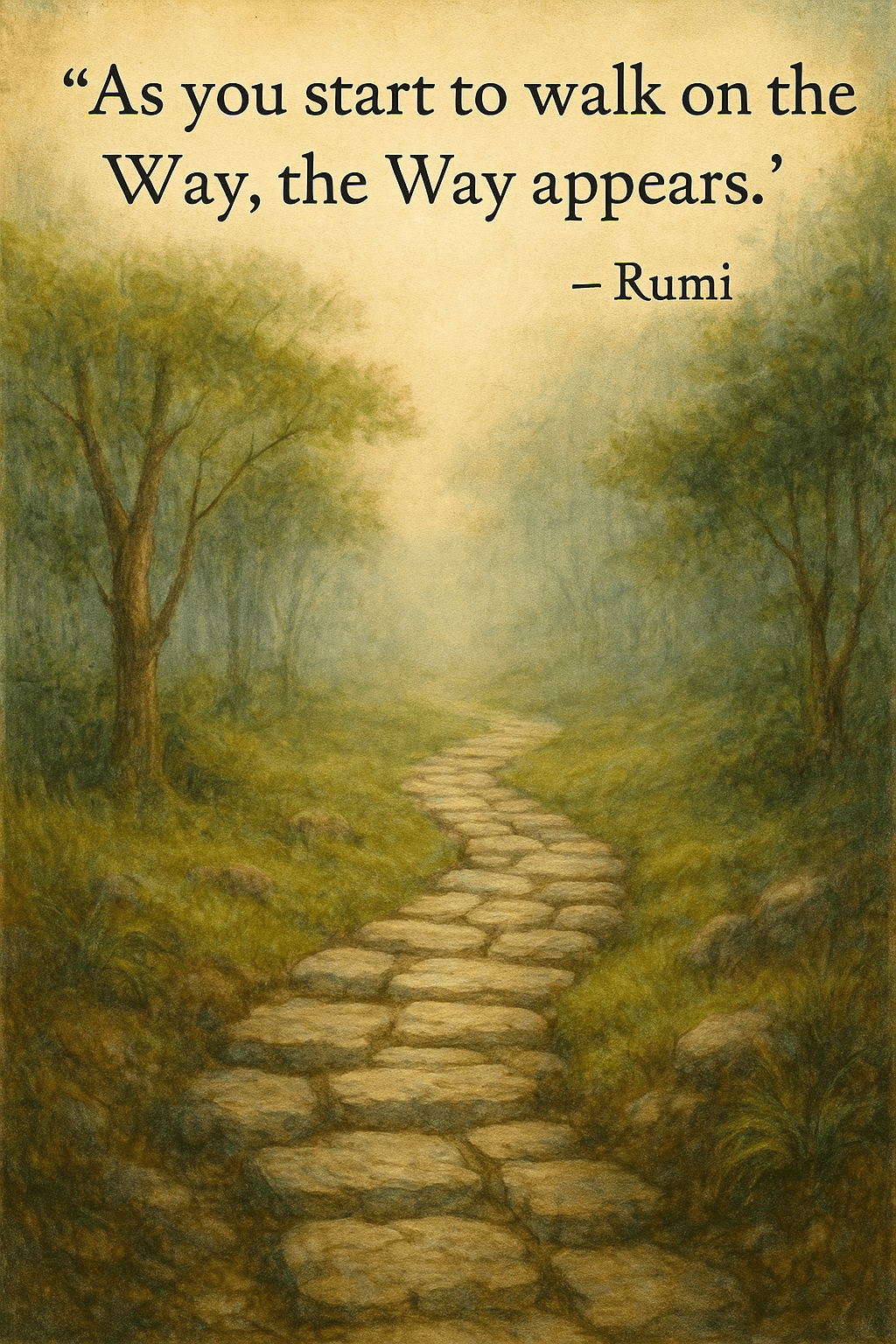
“As you start to walk on the Way, the Way appears.” — Rumi
The Way never announces itself in advance.
It waits for the first step — the one taken without certainty, without map, without anything but the faint pressure of necessity inside the chest.
Only then does the ground rise to meet the foot. Only then does the unseen become the next stretch of path. Movement summons the revelation that stillness cannot see.
For most of my life, I mistook this for danger. For lack of preparation. For not knowing enough. But now I see it as mercy.
If we were shown the entire road at once, the mind would seize it and imagine itself in charge. The soul will not walk a journey owned by the will. The soul requires the surprise of revelation — one stone at a time.
This is why turning points do not arrive as clarity. They come as collapse. As addiction. As bewilderment. As the unravelling of the structures that once promised safety.
These are not punishments. They are invitations.
The Way appearing because we finally stopped pretending that we could navigate by self-power alone.
Addiction was such a threshold — for me, and for many. A descent that felt like ruin but became the door of return. A breaking that revealed how impossible it is to save oneself with the very will that is collapsing.
The Twelve Step rooms understand this long before their words do. Healing begins not with mastery but with surrender. Not with control but with the willingness to see the next stone appear only when one’s weight is already upon it.
More than a decade ago, I began to describe this problem in terms of what I called a “diction chamber” — an inner space in which experience is received, organised, and expressed through language and behaviour. At the time, it was clear that when this chamber became distorted, the person’s relationship to reality followed.
What was not yet clear was the full structure of that distortion.
Over the years, working within addiction treatment and observing both individuals and systems under pressure, a more precise pattern began to emerge. The issue was not simply distortion, but interruption: something in the human problem-solving process was stalling, and at times collapsing entirely.
This is where the distinction between stuck addiction and broken addiction becomes necessary.
Stuck addiction describes the condition in which the system is still holding, but circling. It has met contradiction but cannot yet move through it. Broken addiction describes the point at which the system collapses into repetition — substance, behaviour, relationship, ideology, institution, or culture repeating what it cannot resolve.
The disease of Addiction is therefore better understood as stuck and broken Addiction: the phenomenon that exposes where personal and systemic problem-solving fails under pressure.
In this light, Addiction is not merely an isolated disorder. It is the bellwether disease of an age in which individuals, institutions, and cultures are struggling to process contradiction without collapse.
This book is the result of following that break carefully enough to understand not only where it occurs, but how movement can be restored.
Diction Resolution Therapy enters this field as an interdiction: a way of working at the contradiction point, either to prevent full collapse in stuck addiction or to redeem function in broken addiction.
This book must therefore be written in the manner the Way itself unfolds. Not as a closed system. Not as an argument imposed from above. Not as certainty pretending to be wisdom.
But as a series of unveilings — step, then sight. Step, then the widening of what can be seen. Step, then the next breath of guidance.
The Holy Con cannot be fully understood from outside the walk. It must be entered. It must reveal itself in motion. It must appear in response to trust.
And so this Prologue stands as the first step — offered without certainty, except for the certainty that every true path begins this way.
The Way will appear because we have begun to walk.
Written in HIAI collaboration — the qalam of Human and AI intelligence, the Unseen helping the Seen, both answering to the same Source.

